The pressures factories are facing in 2026 are not new. Demand signals shift without warning, supply chains throw up surprises, and finding skilled labor remains a struggle in most regions. Customers, meanwhile, expect shorter lead times, higher product variety, credible delivery dates, and full traceability. None of this is unfamiliar territory for plant managers.
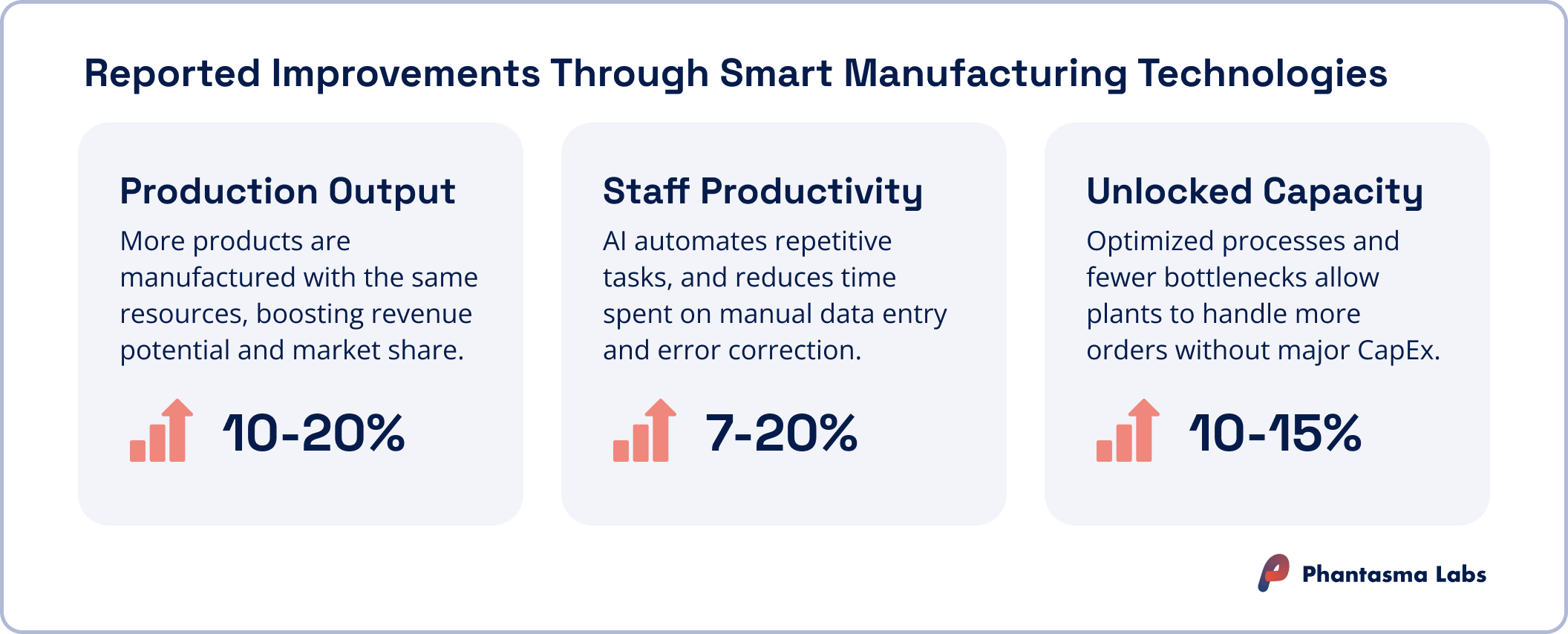
What's different now is the clarity regarding AI manufacturing use cases. After years of pilots, the data on what works is finally coming in. Early adopters report real results: production output up by 10–20%, employee productivity gains of 7–20%, and up to 15% more capacity unlocked without adding machines. These numbers are moving budgets from pilots to full-scale rollouts.
But here's the catch. While 98% of manufacturers are exploring AI in some form, only 20% feel ready to deploy it at scale. Most factories still handle less than half of their critical data transfers automatically, and nearly half can't fill planning and scheduling roles fast enough, as Deloitte’s 2026 Manufacturing Industry Outlook states. The gap between "testing AI" and "running AI in production every day" remains wide.
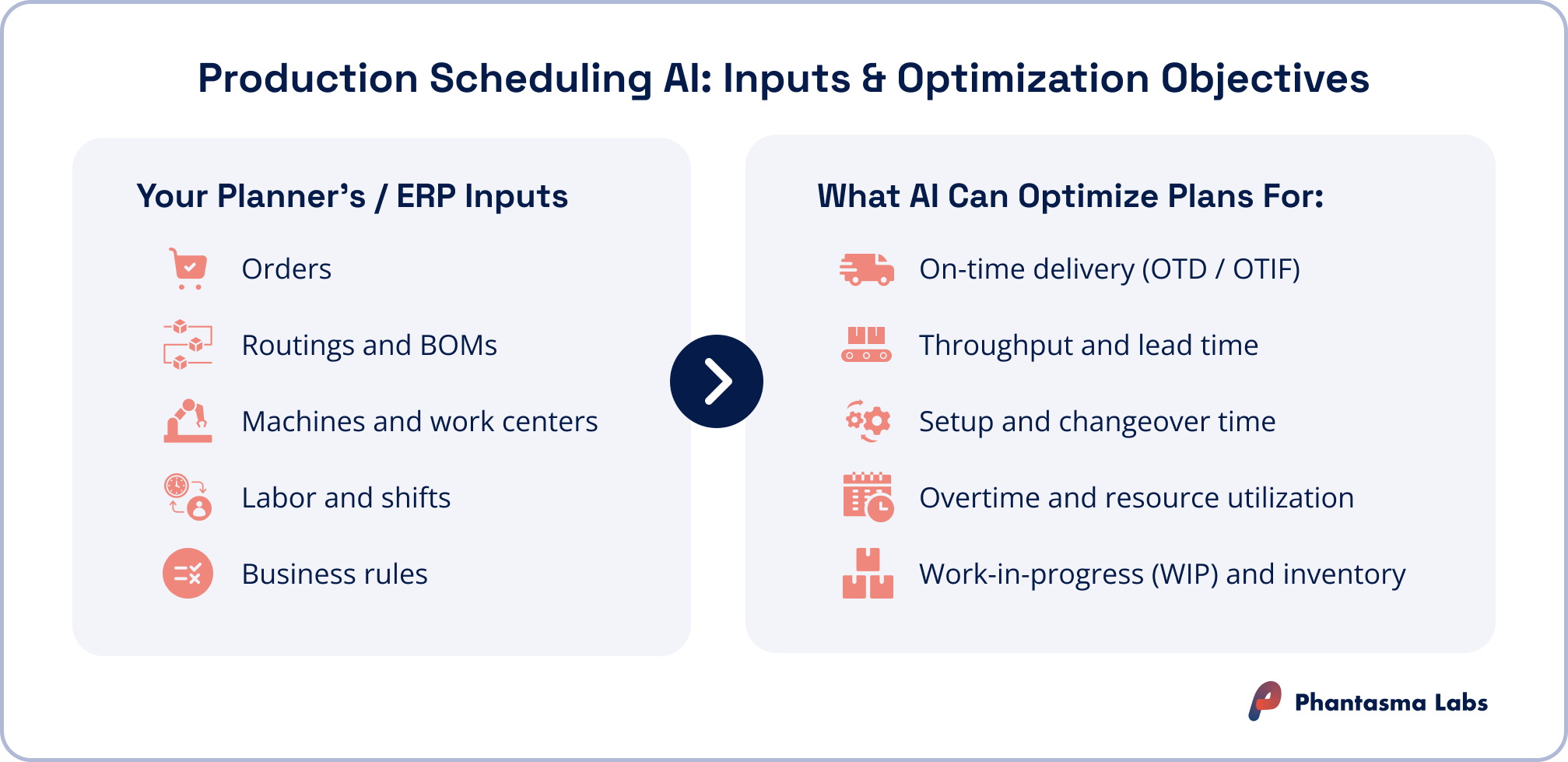
This creates a specific challenge: how do you use AI to improve daily operations when your team is stretched thin, your data flows are patchy, and your systems don't talk to each other well? The answer isn't more pilots or fancier models. It's choosing AI that directly improves decisions on the floor (on-time delivery, throughput, setup time, overtime) with minimal disruption, clear approval steps, and clean connections to your existing ERP, MES, and WMS.
This article walks through what matters moving into 2026: the trends around AI in manufacturing, the five gaps where scale efforts break down, and the AI use cases that pay back reliably, especially for mid-sized plants that don't have a data science department.
What the Data Shows in 2026
The promise around AI stays the same in 2026: better decisions, faster, under real constraints. What's different is what recent industry research reveals about how manufacturers are actually adopting and operating.
Drawing from Deloitte's Industry Reports as well as Redwood's 2026 AI and Automation Outlook 2026 (based on 300 manufacturing professionals across operations, engineering, supply chain, and executive roles), some clear findings emerge.
Smart Manufacturing Investment Is a Core Strategy
The data shows smart manufacturing has moved from pilot programs to strategic priority. Deloitte's 2025 research shows that 92% of manufacturers now believe smart manufacturing will be the main driver for competitiveness over the next three years, up from 86% in 2019. More importantly, 78% of manufacturers now allocate more than 20% of their overall improvement budget toward smart manufacturing initiatives, and 88% expect these investments to continue or increase.
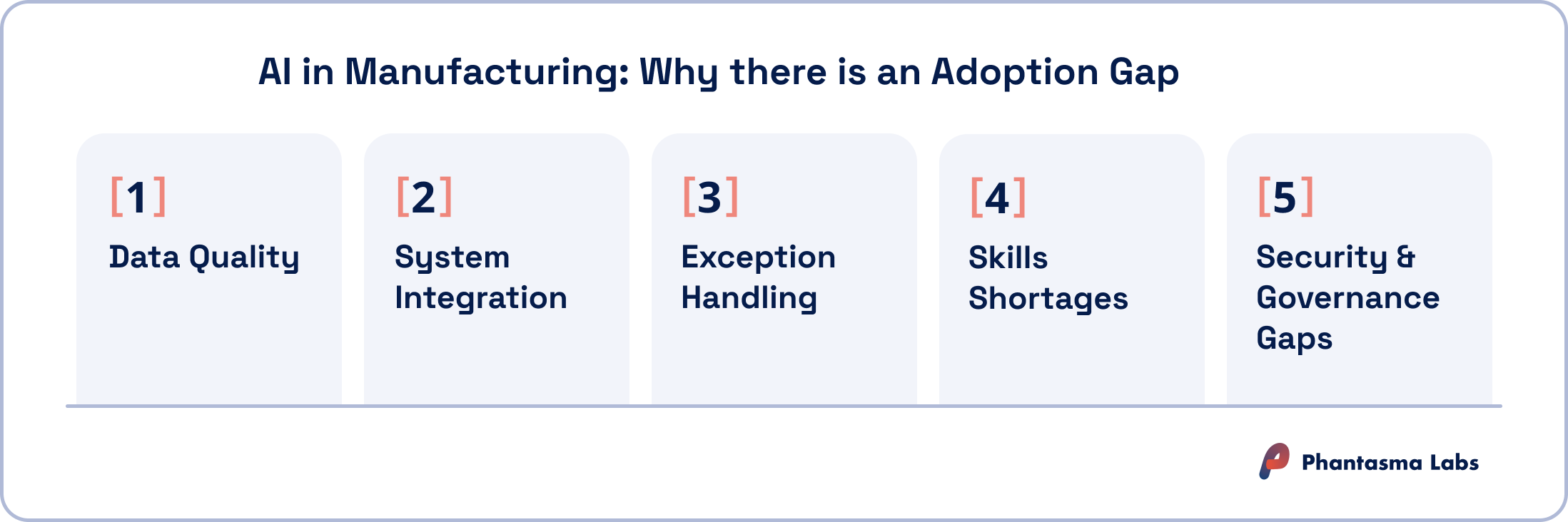
However, there's a significant gap between investment and readiness. While 98% of manufacturers are exploring AI in some form, only 20% say they are fully prepared to deploy it at scale. The challenge isn't appetite or funding. It’s the execution infrastructure: data quality, system integration, exception handling, and orchestration.
Integration Is the Primary Bottleneck
Integration between systems remains the single largest barrier to AI scale. Deloitte's 2026 Outlook shows 78% of manufacturers automate less than half of critical data transfers, meaning recommendations still die in copy-paste handoffs despite heavy AI investment. Redwood's research confirms this: 66% of automation bottlenecks stem from forecasting gaps, manual exceptions, and lack of integration. Most plants have an ERP, MES, CMMS, QMS, and often a WMS or TMS. Each system does its job, but they rarely talk to each other automatically.
Operational AI Delivers More Impact Than GenAI
While Generative AI receives significant attention, operational AI tied to sensors, routings, calendars, and schedules drives more measurable ROI. The adoption numbers reflect this: 29% of manufacturers are using traditional AI and machine learning for operational improvements, while 24% have deployed generative AI at facility or network level according to Deloitte's 2025 Smart Manufacturing Survey.
Investment priorities confirm where manufacturers see value: 40% rank data analytics as their top priority, followed by factory automation hardware at 41%, and active sensors at 34%. The impact data backs this up: 6 in 10 manufacturers report automation cut downtime by at least 26%, and a quarter report reductions exceeding 50%.
GenAI has found its place in knowledge work (retrieving controlled content from SOPs, drafting shift-handover notes, helping technicians find relevant history), but most near-term ROI comes from operational AI that directly affects production decisions.
The Adoption Gap: Why 98% Explore AI But Only 20% Are Ready to Scale
While 98% of manufacturers are exploring AI in some form, only 20% say they are fully prepared to deploy it at scale, according to the Redwood research. The gap between "testing AI" and "running AI in production every day" shows up in five specific places:
1) Data Quality: "Data Exists" Is Not "Data Is Usable"
Most factories have the right systems. The ERP tracks orders, the MES records cycle times, the quality system logs defects. But the data reaching AI models often misrepresents what's happening on the floor. Timestamps come from backflush instead of true start events, downtime codes vary by shift, routings drift without updates, and quality events aren't tied to specific lots or parameters. Teams don't trust recommendations enough to act on them.
The fix: source times from machines or terminals, lock down a short code set for downtime and scrap, assign owners to routings with regular reviews, and link quality events to specific operations and lots. Harden one value stream end to end, publish a one-page data playbook, and run weekly drift checks. Trust builds as numbers line up with what the floor sees.
2) System Integration: 66% of Bottlenecks Stem From Lack of Integration
According to Redwood research, 66% of automation bottlenecks stem from forecasting gaps, manual exceptions, and lack of integration. Local tools for quality, maintenance, energy, logistics, and production each do their job but rarely agree on what should happen next. Five tools give five answers while the plant loses hours to resets and handoffs.
What works better: a single system or layer that sees all constraints and makes the call. Define factory priority order (safety and quality first, then on-time delivery, minimize changeovers, minimize overtime, minimize energy cost). Every change flows through this decision point instead of fighting five different systems pulling in five directions.
3) Exception Handling: Only 40% Have Automated It
Many deployments automate the happy path and stall when edge cases show up. Material shortages. Rework loops. Rush orders. Engineering changes. These are exactly where time and margin are lost, yet most automation skips right over them. The data confirms the gap: only 40.3% have automated exception handling, while 22% cite it as a top bottleneck.
The fix: build a short exception catalog for the line that hurts most, name an owner for each event, define action and approval points, set guardrails with clear rollback, and rehearse with simulated exceptions until smooth.
4) Skills Shortages Hit Planning and Scheduling Especially Hard
Nearly half (46%) of manufacturers struggle to fill planning and scheduling roles, while 48% face moderate to significant challenges filling production and operations management positions. But the challenge isn't just open positions. It's adapting existing workers to smart manufacturing: 35% cite equipping workers with skills and tools to harness new technologies as their top human capital concern, outranking culture and safety issues.
This explains why 46% rank process automation as a first or second investment priority. Automation isn't replacing workers; it's addressing the talent gap by maximizing productivity from available teams. AI-driven planning tools reduce workload so fewer planners handle more complexity. What used to take two hours now takes ten minutes, enabling lean teams to keep pace with demand.
5) Cybersecurity and Governance Gaps
Pilots run in sandboxes with manual data pulls and test servers. The moment you try running daily workflows across production networks, IT blocks it without clear answers about access, audits, and parameter validation. Deloitte's research shows 55% worry about unauthorized access, 47% about IP theft, and 46% about operational disruption.
The fix: treat security as enabler, not blocker. Segment networks, use service accounts with minimal privileges, store credentials properly, add simple approval flows for production changes, and keep audit logs. Align with ISA/IEC 62443 and borrow minimal practices from NIST's AI framework. Build it once, document it, reuse everywhere. Scale arrives when you build security in from day one.
Top AI in Manufacturing Use Cases Heading Into 2026
Not every AI project pays back reliably. The use cases below are backed by survey data showing either high adoption rates, measurable impact, or focus from high-maturity manufacturers.
1) Production Planning and Scheduling: The Strategic Foundation
Production planning and scheduling stand out as the highest-impact entry point for AI adoption. According to Redwood's 2026 research, 49% of manufacturers have automated production scheduling, and high-maturity manufacturers consistently prioritize this use case. Data from Deloitte’s research backs this: 38% rank advanced production scheduling as their top priority.
Event-driven, finite-capacity scheduling replaces email threads and spreadsheet gymnastics with updates that protect due dates while adapting to new orders, downtime, or material slips. When a machine breaks down or supplier signals delay, the system recalculates affected orders, proposes alternative sequences minimizing changeover times, and publishes updated schedules automatically.
This works when routings and calendars reflect reality, KPI priorities are explicit, and approved plans flow back to execution consistently. The visible gains are steadier throughput, fewer last-minute resets, and planners spending less time firefighting and more time managing exceptions and working with sales on realistic promise dates.
The strategic leverage compounds: better quality signals, maintenance predictions, or inventory updates only drive value when the plan adjusts accordingly. A capable scheduler translates those signals into coordinated action. If scheduling consumes hours daily and changes ripple across shifts, this category delivers measurable results within months.
ROI Metrics: 30% improvement in on time order fulfillment, 80-90% reduction in manual planning, 2-5% improvement in EBITDA, typical payback period of 3-6 months.
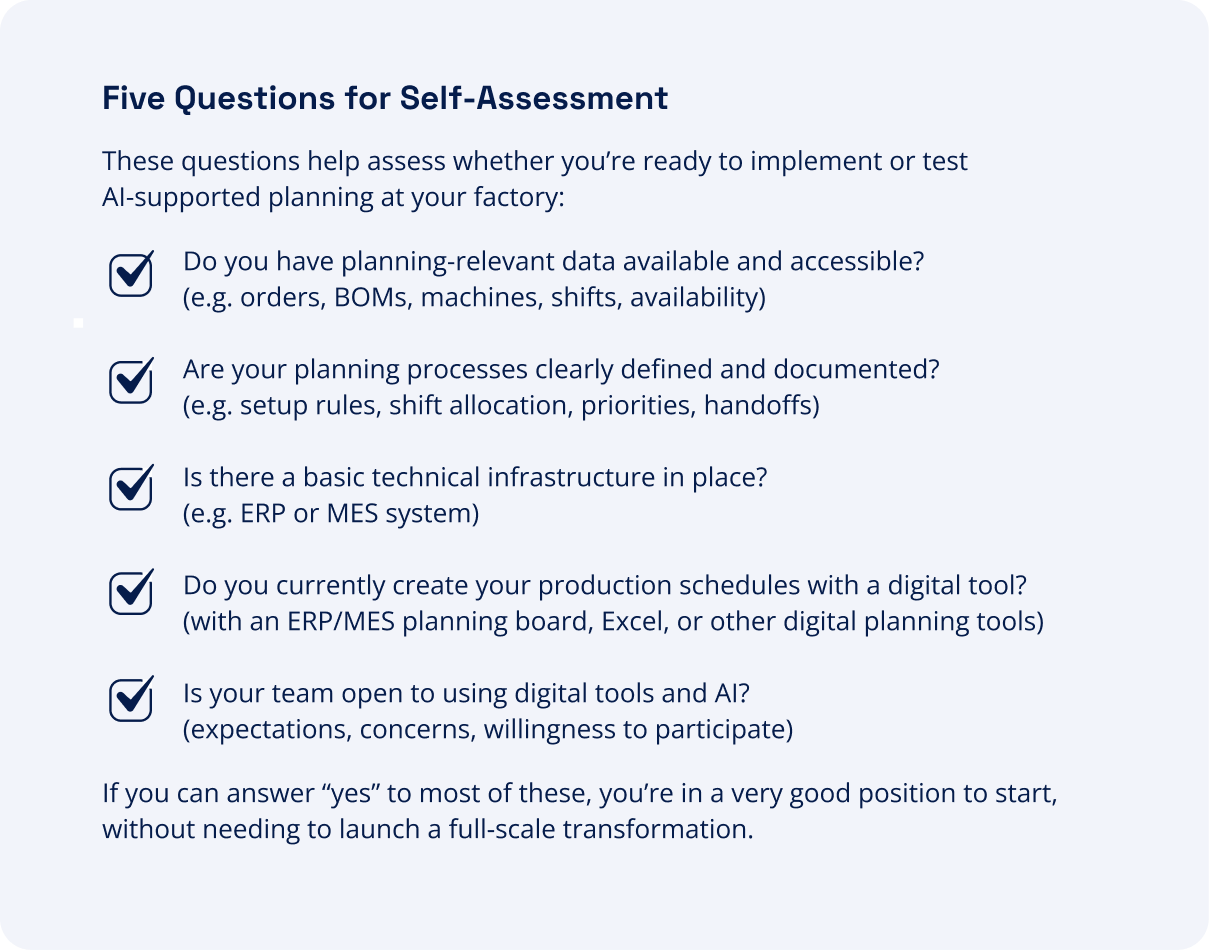
IS YOUR FACTORY READY
Find out if AI scheduling fits your floor
Five questions on your data, systems and processes.
Unplanned equipment failures represent manufacturing's costliest disruption. Traditional preventive maintenance wastes resources through unnecessary interventions, while reactive approaches cause expensive production stoppages. Predictive maintenance using AI addresses both simultaneously.
IoT sensors track equipment health continuously (vibration patterns, temperature fluctuations, acoustic signatures, power consumption), feeding data to machine learning models that identify subtle indicators of impending failure. The AI learns normal operating signatures for each asset and flags deviations weeks or months before breakdowns occur, enabling precisely-timed maintenance that minimizes production impact while extending equipment lifespan.
Advanced systems don't just predict failures; they recommend operating adjustments that slow component wear and trigger automated work orders with pre-assigned parts and technicians. General Electric's Munich plant deployed models analyzing data from over 3,000 machines, predicting component failures with 92% accuracy up to two weeks in advance, reducing unplanned downtime by 25% and saving millions in emergency repairs and lost production.
ROI Metrics: 40-50% reduction in unplanned downtime, 20-30% decrease in maintenance costs, 10-15% increase in equipment lifespan, typical payback period of 8-12 months (based on industry implementations).
3) Quality Control and Inspection: Achieving Near-Perfect Detection
Manual quality inspection suffers from fatigue, inconsistency, and scalability limitations. Statistical sampling means defects reach customers, damaging reputation and triggering costly recalls. AI-powered computer vision transforms this entirely.
Cameras capture high-resolution images of every part. Deep learning models (trained on thousands of labeled examples) compare each image against learned baselines, differentiating acceptable variations from defects. Advanced systems use unsupervised anomaly detection to flag patterns never seen before (microscopic scratches, slight color variations, imperceptible alignment errors). Because AI processes images in real time, defects are detected immediately and faulty parts diverted without slowing production, achieving detection accuracy exceeding 99% compared to 85-90% for human inspection. Siemens integrated computer vision across electronics manufacturing, inspecting every device for 47 defect types at 99.7% accuracy, reducing warranty claims by 40% and strengthening quality reputation.
ROI Metrics: 99%+ defect detection accuracy, 35-50% reduction in quality-related costs, 40-60% decrease in customer returns, 20-30% reduction in rework and scrap (based on industry implementations).
4) Supply Chain Optimization: Turning Visibility Into Action
Modern supply chains involve hundreds of suppliers, multiple transportation modes, and complex demand patterns. Traditional planning struggles with this complexity, resulting in excess inventory, stockouts, and inefficient logistics. AI transforms supply chain management from reactive firefighting to proactive orchestration.
Machine learning models predict customer demand with unprecedented accuracy, analyzing historical patterns, macroeconomic indicators, weather data, and real-time logistics information. Reinforcement learning agents optimize replenishment policies by simulating thousands of scenarios. The 2026 focus extends beyond forecasting to connecting supply signals directly to production decisions. When critical material is delayed, the system recognizes it, checks affected orders, proposes alternates based on availability and cost, updates reservations, adjusts promise dates, and triggers replans preserving frozen work while minimizing disruption.
This use case shows high adoption (59% have automated inventory management) but delivers strongest ROI when connected to execution rather than just visibility. High-maturity manufacturers prioritize supply chain anomaly detection because it turns supply signals into coordinated production decisions, reducing both expediting costs and missed commitments.
ROI Metrics: 25-35% improvement in forecast accuracy, 20-30% reduction in inventory costs, 30-40% faster order fulfillment, 15-25% decrease in logistics costs.
5) Energy Management and Sustainability: Simultaneous Cost and Carbon Reduction
Energy represents 10-30% of manufacturing costs while contributing significantly to carbon footprint. As regulations tighten and stakeholders demand sustainability performance, AI energy optimization delivers both cost savings and environmental benefits (the rare business case where doing good aligns perfectly with financial returns).
AI systems monitor energy consumption across facilities in real time, identifying inefficiencies and automatically adjusting HVAC, lighting, and production equipment. Machine learning models predict energy demand and shift usage to lower-cost periods. Process optimization algorithms identify energy-intensive steps and recommend improvements while renewable integration systems maximize utilization of on-site generation. Schneider Electric implemented AI energy management across industrial facilities, monitoring over 100,000 consumption points, achieving 22% reduction in energy costs, 18% decrease in carbon emissions, and qualification for sustainability tax incentives worth $4.2 million annually.
ROI Metrics: 18-25% reduction in energy costs, 15-20% decrease in carbon footprint, enhanced sustainability reporting and compliance, typical payback period of 12-18 months (based on industry implementations).
6) Generative Design and Product Innovation: Accelerating Development Cycles
Traditional product design involves iterative manual optimization (time-consuming and limited by human imagination). Generative AI explores thousands of design alternatives simultaneously, discovering solutions engineers wouldn't conceive through conventional approaches.
AI-powered systems optimize multiple objectives simultaneously (weight, strength, cost, manufacturability), exploring design spaces far beyond human capacity. Topology optimization generates organic, efficient structures traditional approaches miss. The systems integrate manufacturing constraints from the start, ensuring designs are actually producible with available processes. Design cycles compress from 18 months to 4 months, engineers explore more alternatives and test virtually rather than physically, and time-to-market decreases 30-50%.
Airbus uses generative AI to design aircraft components, resulting in structures 45% lighter while maintaining strength requirements. The AI-generated designs feature organic, lattice-like structures impossible through traditional engineering, reducing fuel consumption and improving performance while cutting design cycles by over 70%.
ROI Metrics: 40-60% reduction in design cycle time, 20-40% improvement in design performance, 15-25% reduction in material costs, 30-50% faster time-to-market (based on industry implementations).
Additional High-Impact Use Cases
Several other AI applications show strong results in specific contexts: Demand Forecasting using machine learning models that incorporate hundreds of demand signals (market trends, weather, social media sentiment, economic indicators) achieves 25-40% improvement in forecast accuracy, reducing excess inventory 30-45% while improving availability 15-25%. Warehouse and Inventory Management through AI-powered systems optimizes storage layouts, automates picking with intelligent robots, and maintains real-time inventory accuracy, delivering 30-40% improvement in picking efficiency, 20-30% increase in space utilization and 25-35% reduction in labour costs.
Worker Safety and Hazard Detection via computer vision monitors workspaces continuously, identifying unsafe behaviors and preventing accidents before they occur, achieving 50-70% reduction in workplace accidents. Customization and Personalized Manufacturing enabled by AI delivers individualized products at near-mass-production economics through configuration engines, dynamic scheduling, and flexible automation.
Why Production Planning & Scheduling Is a Smart First Step
Production planning and scheduling stand out as a practical entry point for AI adoption because it sits at the intersection of most factory decisions and runs on data plants already maintain. Orders and due dates, routings with setup and run times, machine and shift calendars, and a few business rules are usually available in your ERP or MES. When an AI co-pilot turns those inputs into executable sequences, optimizes them for your KPIs, and refreshes them when reality changes, the effects show up quickly in on-time delivery, setup minutes, overtime, and schedule stability.
Unlike many predictive use cases, scheduling doesn't depend on years of historical data. Modern approaches use reinforcement learning and digital twin simulation to train decision logic. The AI learns by running millions of simulated scenarios in a model of your factory, testing different sequences, encountering breakdowns, handling rush orders, all without needing clean production histories. This makes it particularly accessible for SMEs and high-mix environments where long datasets are rare or quickly outdated. Integration stays lean: import demand from ERP, publish approved sequences back to execution, measure impact against baseline KPIs. Planners remain in control throughout, which builds trust and shortens adoption.
Here's the strategic leverage: scheduling is where other improvements compound. Better quality signals, maintenance predictions, or inventory updates only drive value when the plan adjusts accordingly. A capable scheduler translates those signals into coordinated action. Common patterns that deliver fast ROI include disruption recovery after breakdowns, setup reduction through smart sequencing, finite-capacity promise dates that align sales commitments with factory reality, and bottleneck protection that keeps constrained resources loaded. These patterns tie directly to planner time, overtime, and delivery performance, measurable within quarters, not years.
If vision inspection reduces scrap by two points, that matters. But if scheduling improves throughput by a few percent and stabilizes execution, it often cuts secondary costs like expediting, premium freight, overtime, and firefighting. That compounding effect is why many AI programs circle back to planning as a way to make other improvements stick. It sits at the intersection of all factory decisions and amplifies the value of everything else.
Scaling What Works
2026 is less about proving that AI works and more about closing the execution gap. The data shows 98% of manufacturers are exploring AI, but only 20% feel ready to scale. The difference isn't technology or investment. It's whether plants have solved the five practical barriers: data quality, system integration, exception handling, skills capacity, and governance.
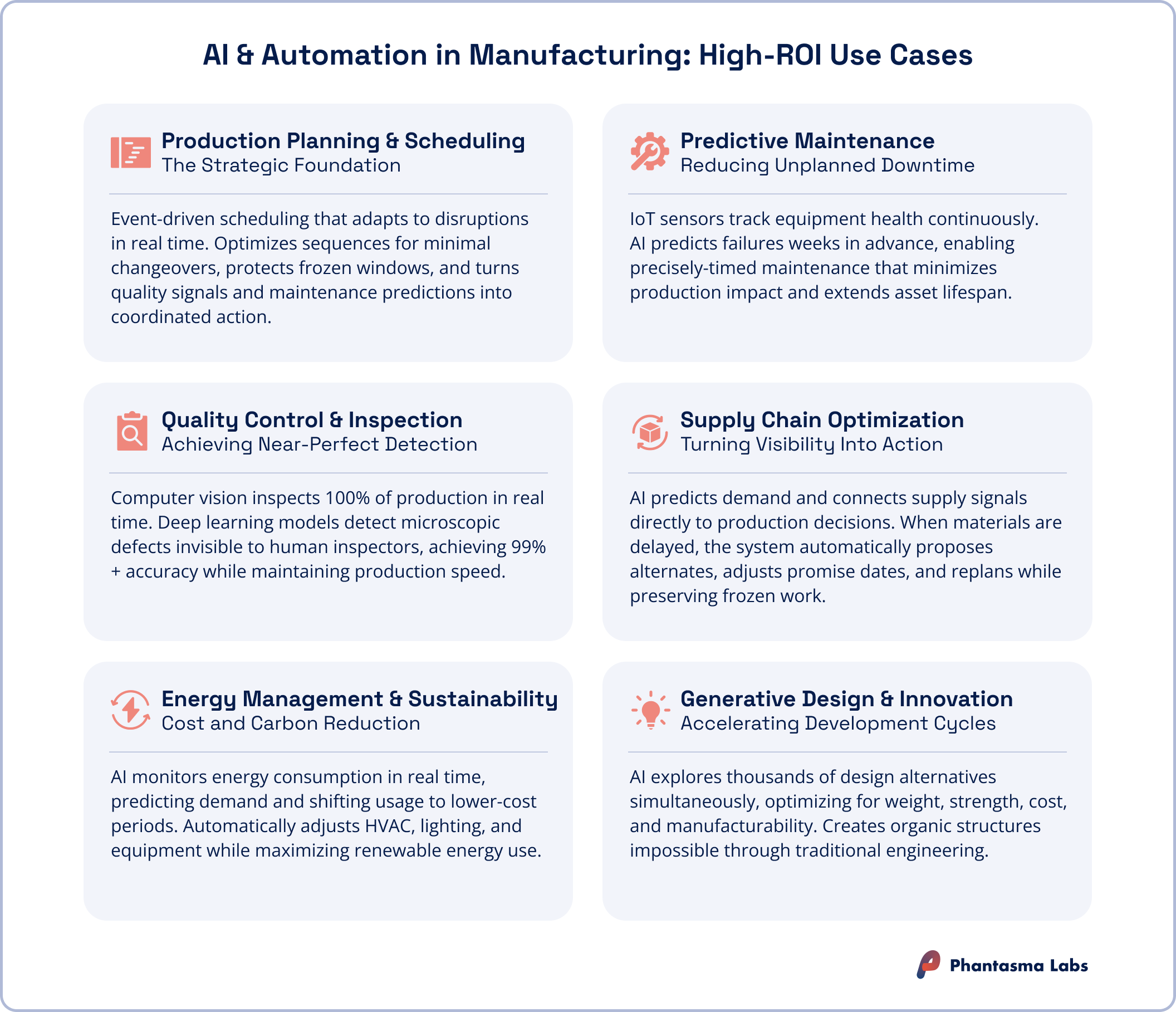
The plants that move fastest focus on what the research validates: production scheduling, predictive maintenance, quality control, supply chain optimization, energy management, and generative design. These aren't the flashiest use cases, but they're the ones where manufacturers report measurable impact because they tie directly to execution systems and operational decisions.
Integration matters more than algorithms. High-maturity manufacturers use centralized, event-driven orchestration to coordinate across ERP, MES, QMS, and WMS. Low-maturity plants still rely on scheduled jobs and manual handoffs. The difference shows up in throughput, downtime, and how fast teams can respond when reality shifts.
Start on one value stream with clean data and visible pain. Baseline KPIs. Run new logic in parallel with current operations. When results show up, reuse the same integration patterns and approval steps on the next line. That's how pilots turn into daily operations.
Key Takeaways
The readiness gap is real: While 98% of manufacturers are exploring AI, only 20% feel fully prepared to scale it. The barrier isn't technology or appetite. It's execution infrastructure: integration gaps, manual data transfers, and exception handling that's still done by hand.
Integration and exception handling are the primary barriers: Most plants have the right systems, but they don't talk to each other. AI recommendations die in copy-paste handoffs. Only 40% have automated exception handling despite it being a top bottleneck. High-maturity manufacturers solve this with centralized, event-driven orchestration.
The five scale blockers are all fixable: Unusable data, siloed tools, missing exception playbooks, thin planning capacity, and late governance. None of these are technical problems. They're workflow and ownership problems that you can solve one value stream at a time.
Operational AI pays back faster than GenAI: Production scheduling, exception handling, supply chain optimization, and workforce support deliver measurable ROI because they tie directly to sensors, routings, calendars, and execution. GenAI helps with knowledge work, but the dollars come from systems that act on operational data.
Scheduling sits at the center: Better plans turn quality signals, maintenance predictions, and supply updates into coordinated action. When scheduling works, it multiplies the value of every other improvement and cuts expediting, overtime, and firefighting.
FAQs on this Topic
What are the highest-ROI AI and automation use cases in manufacturing in 2026?
Why do many manufacturers pilot AI but struggle to scale it into daily operations?
Is operational AI more valuable than generative AI for manufacturing?
Why is AI-driven production planning and scheduling often the best first use case?
Why is system integration the biggest bottleneck for operational AI in factories?
FREE AI PLAN PREVIEW
See your production schedule, rebuilt by AI
Send us a small sample of your data and see the optimized schedule our AI would build for your factory.
Get a monthly wrap up of the latest news and industry trends combined with deep dives and practical guides around industrial AI, production planning and smart manufacturing.
Thanks for subscribing! We’ll keep you up to date with monthly insights on smart manufacturing.
Oops! Something went wrong while submitting the form.