.png)
Planning and scheduling have quietly become one of the biggest financial levers in modern factories. When schedules slip, you feel it immediately in overtime, expediting costs, missed delivery dates, and unused capacity. When schedules are tight and realistic, the opposite happens: throughput increases, fire-fighting decreases, and you can often grow output without adding new machines.
In Deloitte’s 2025 Smart Manufacturing Survey, companies deploying smart manufacturing technologies – including AI for production planning – reported double-digit gains in production output, employee productivity and up to 15 % more unlocked capacity. At the same time, almost half of manufacturing executives report difficulty filling planning and scheduling roles, while order mixes get more complex and disruptions more frequent.
Against this backdrop, it’s no surprise that many leadership teams are asking a direct question: What is the real ROI of AI-driven production scheduling, how fast do we see it and is the adoption process worth the effort for our factory?
In this article, we’ll unpack:
- What production scheduling AI actually is (and what it is not)
- How AI-driven production scheduling works in practice
- Where the ROI of AI-driven production scheduling shows up in P&L and KPIs
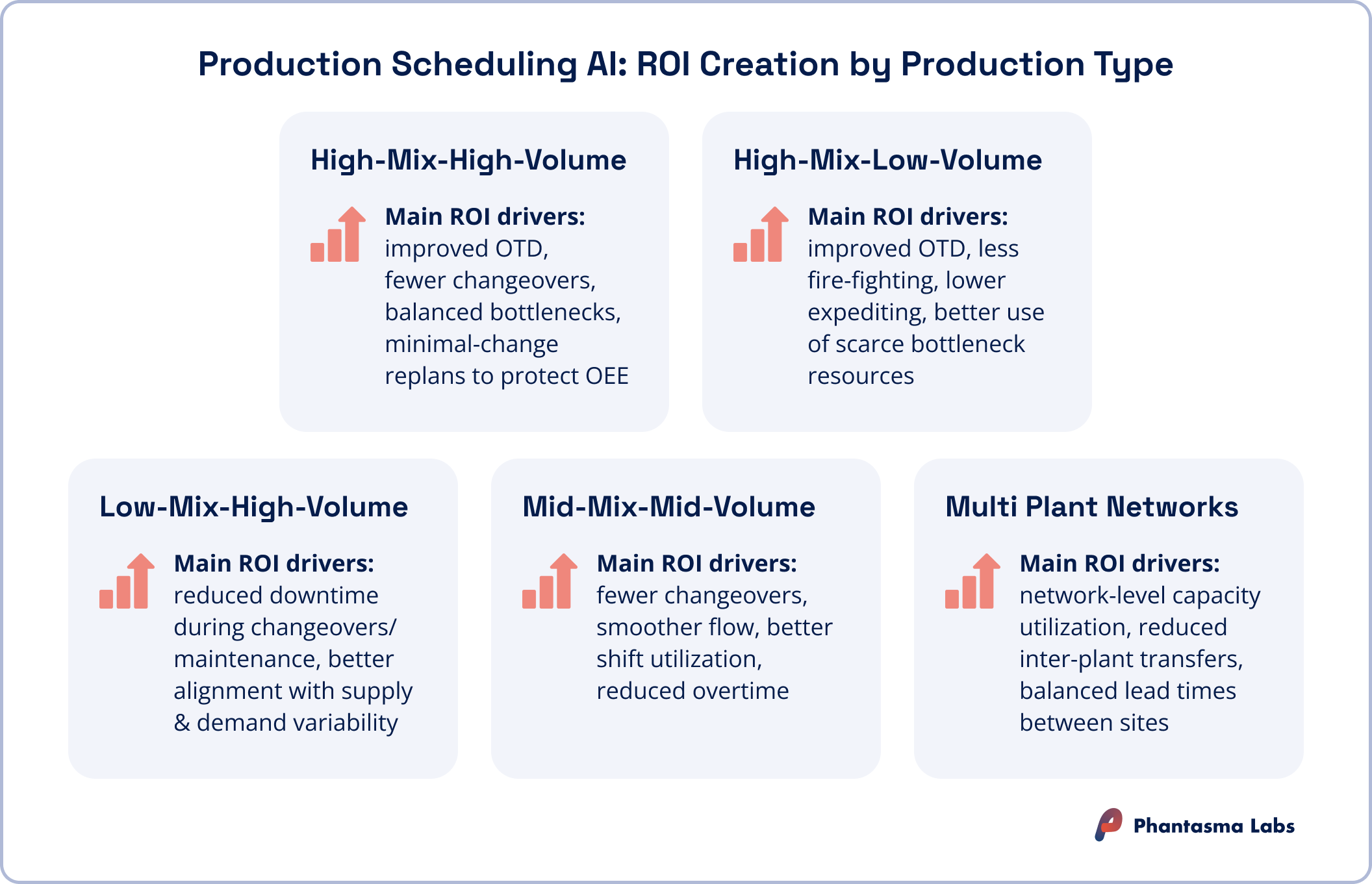
- How the ROI of production scheduling AI differs for different factory types and sizes
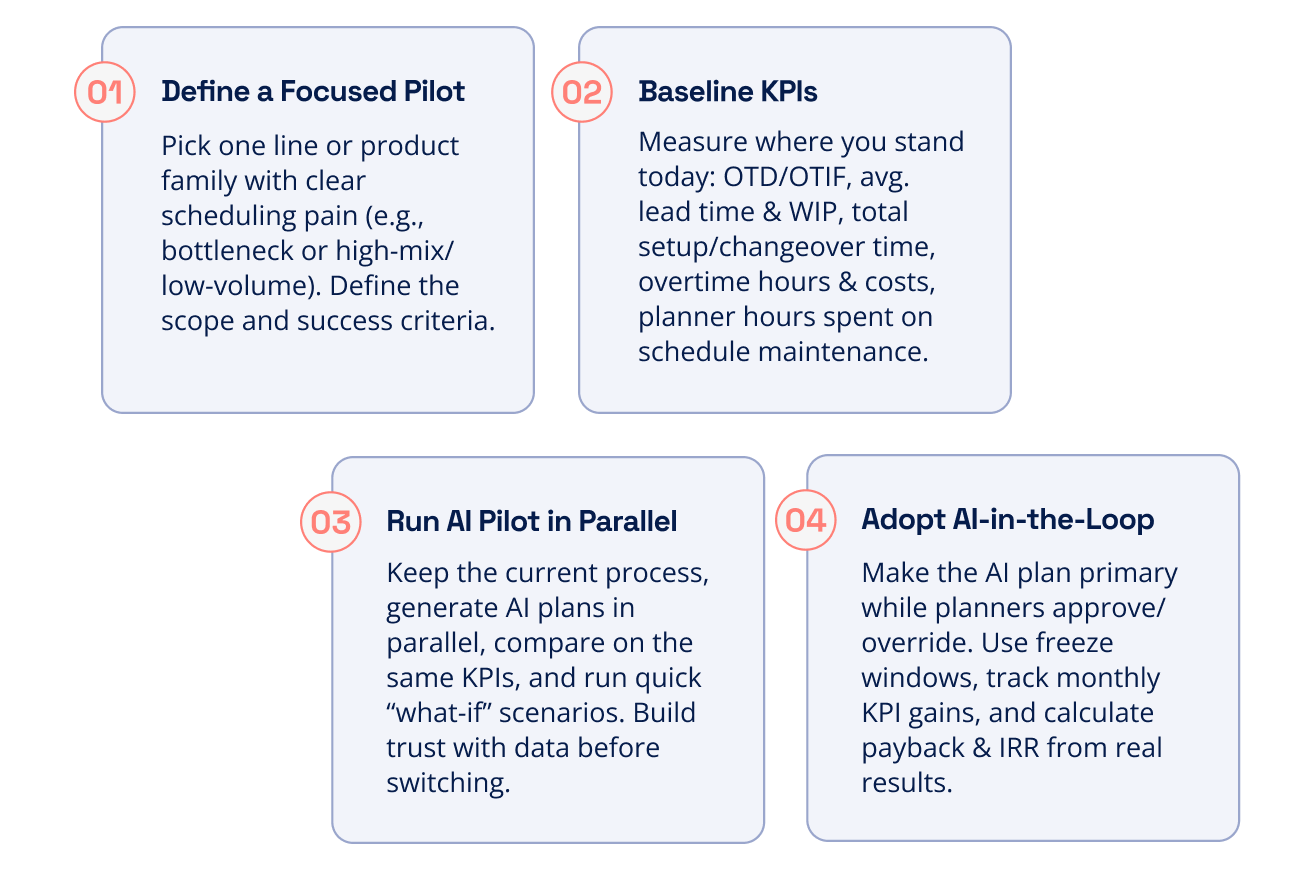
- Practical ways to start, measure, and de-risk a production scheduling AI pilot
- Why reinforcement learning based AI offers a fast, low-investment path, without years of historical data
In other words, we will look at the impact of production scheduling AI on service, throughput, inventory, and labour cost, and what that means for the ROI of AI-driven production scheduling in real factories. Throughout, the focus is on giving factory and operations leaders a clear, numbers-based view of the ROI of AI-driven production scheduling so you can judge whether and where it makes sense for your own plants.
What Is Production Scheduling AI?
Before calculating the ROI of AI-driven production scheduling, it helps to be precise about what we mean by production scheduling AI.
At its core, production scheduling AI is specialized decision-support software that uses advanced algorithms – often machine learning or reinforcement learning – to automatically generate and update factory schedules. Instead of planners manually juggling Excel sheets, rules of thumb and experience, a production scheduling AI evaluates millions of feasible sequences within seconds and surfaces the best options against your KPIs.
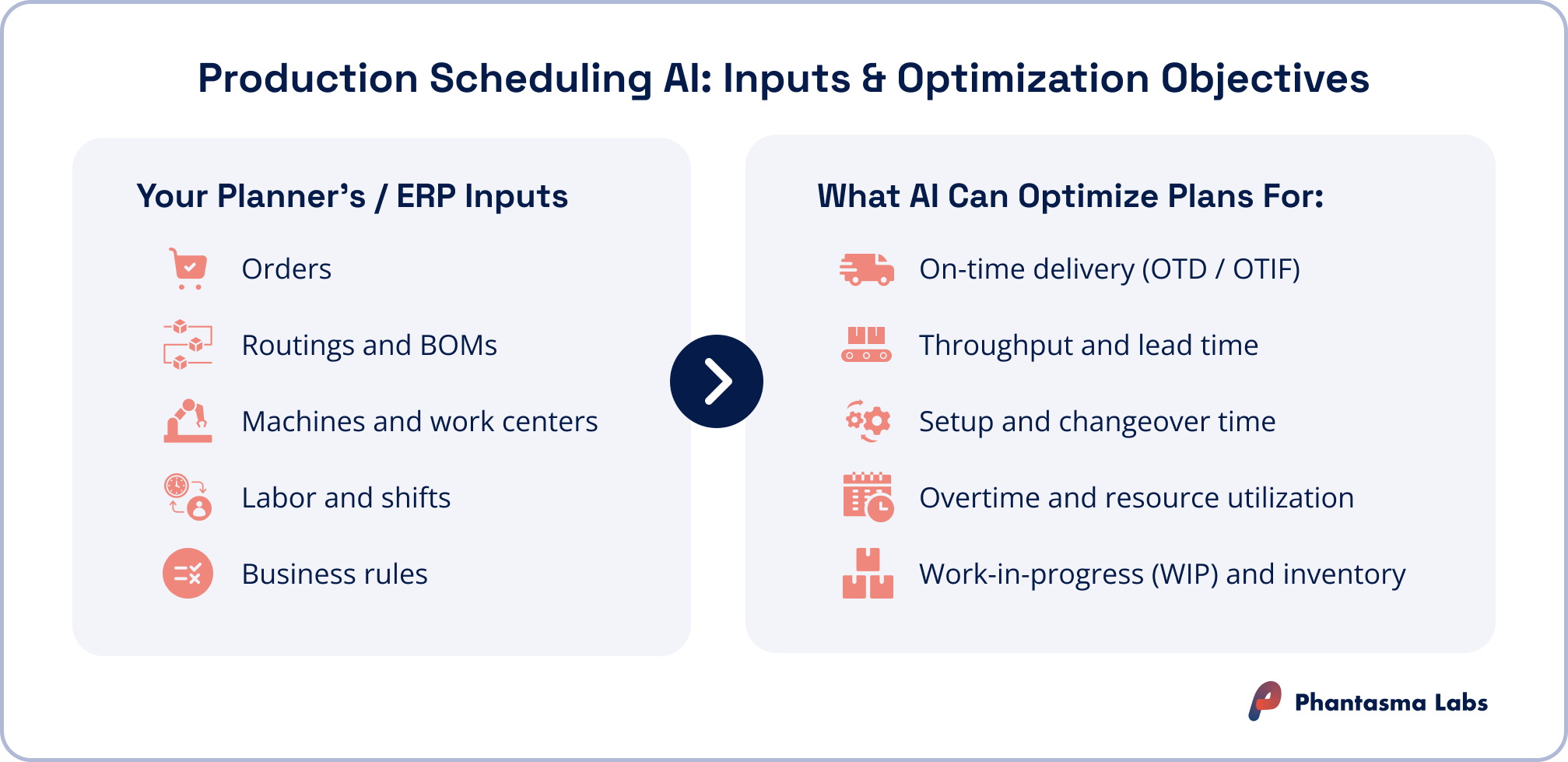
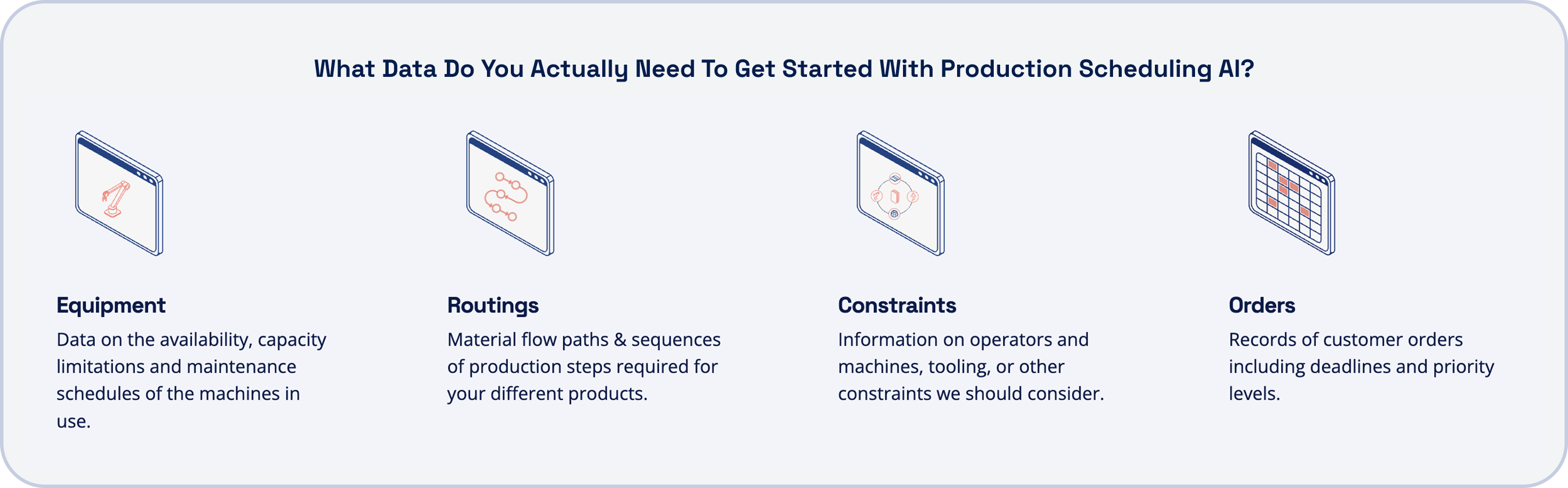
Typical inputs for a production planning AI include:
- Orders (quantities, due dates, priorities)
- Routings and BOMs (operations, setup and run times, alternative machines)
- Machines and work centers (capacities, calendars, maintenance windows)
- Labor and shifts (crews, skills, shift models)
- Business rules (freeze windows, sequencing preferences, WIP limits)
A production scheduling AI then outputs one or more capacity-feasible schedules that respect constraints and are optimized for KPIs such as:
- On-time delivery (OTD / OTIF)
- Throughput and lead time
- Setup and changeover time
- Overtime and resource utilization
- Work-in-progress (WIP) and inventory
The most effective systems don’t replace the planner. They act as an AI co-pilot: generating plans, explaining trade-offs, and allowing planners to adjust or override as needed. This collaboration between expert planners and AI in manufacturing is what ultimately drives the ROI of AI-driven production scheduling.
How AI-Driven Production Scheduling Works in Practice
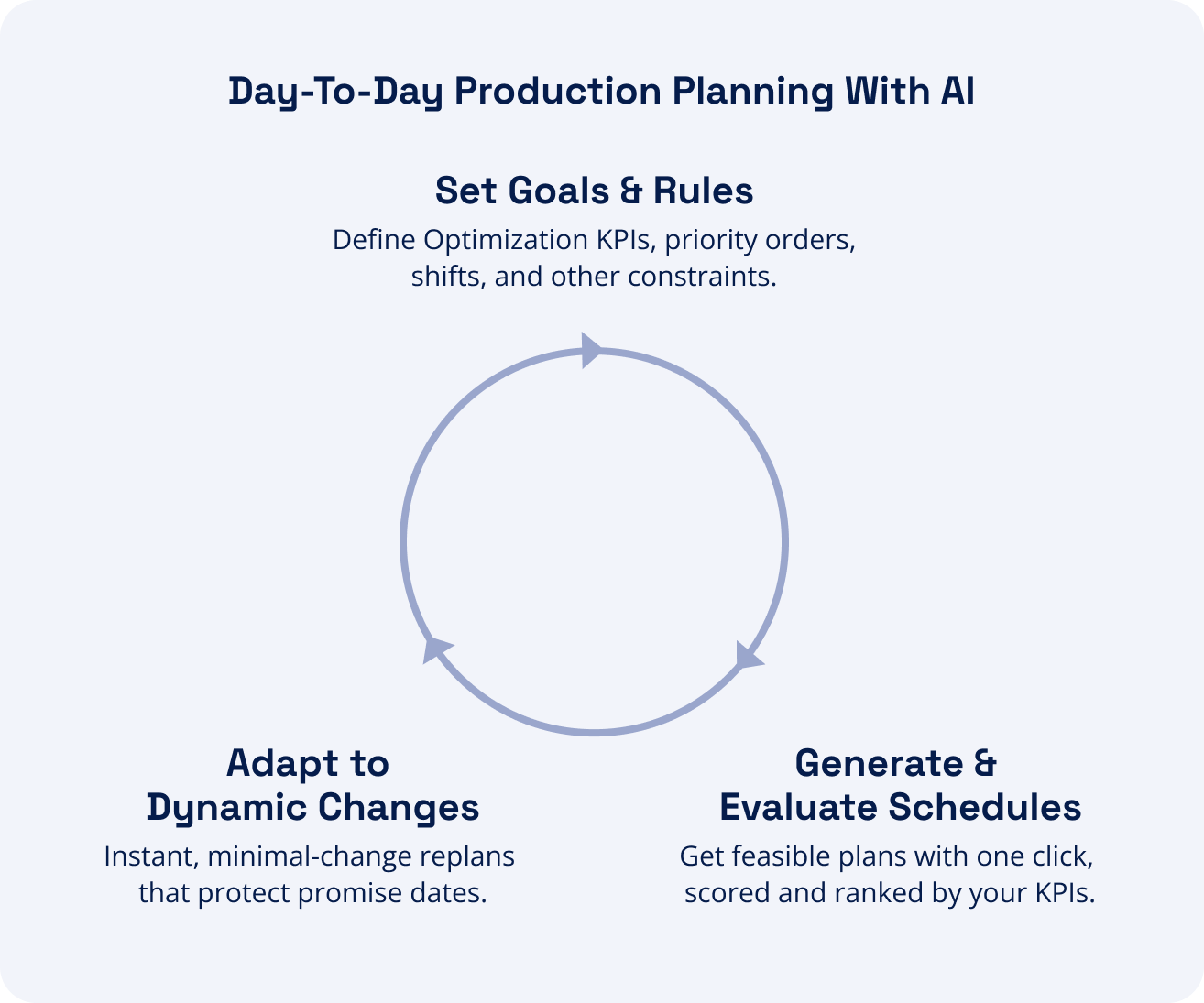
For many factory teams, the value of AI feels abstract until you see how it changes the daily planning routine. A typical workflow with AI for production planning looks like this:
1. Define goals and constraints
The planning team configures the rules of the game: which KPIs to prioritize (for example, OTD versus changeovers), what parts of the horizon are frozen, which orders or operations are of high priority, and which business rules must never be violated.
2. Import or sync data from ERP / MES
Orders, routings, calendars and current WIP are imported from existing systems. Most production scheduling AI tools integrate via APIs or file exports to avoid duplicate data entry.
3. Generate and compare schedules
With one click, the production scheduling AI creates one or several feasible schedules. Each proposed schedule is scored against your KPIs: OTD percentage, total setup time, shift utilization, lateness cost, and so on. Planners can compare scenarios – e.g. “maximise on-time delivery” versus “minimise changeovers” – and select the best trade-off.
4. Publish to the shop floor
Once agreed, the selected schedule is published back to the planning board, ERP or MES. Operators see updated sequences, start times and resource assignments.
5. Adapt when reality changes
When a machine fails, a rush order arrives or a material delay appears, the planner updates a few parameters and asks the AI to replan. The production scheduling AI proposes a minimal-change update: keeping frozen operations stable while resequencing where necessary. This is where the dynamic ROI of AI-driven production scheduling becomes very tangible – minutes instead of hours to recover from disruptions.
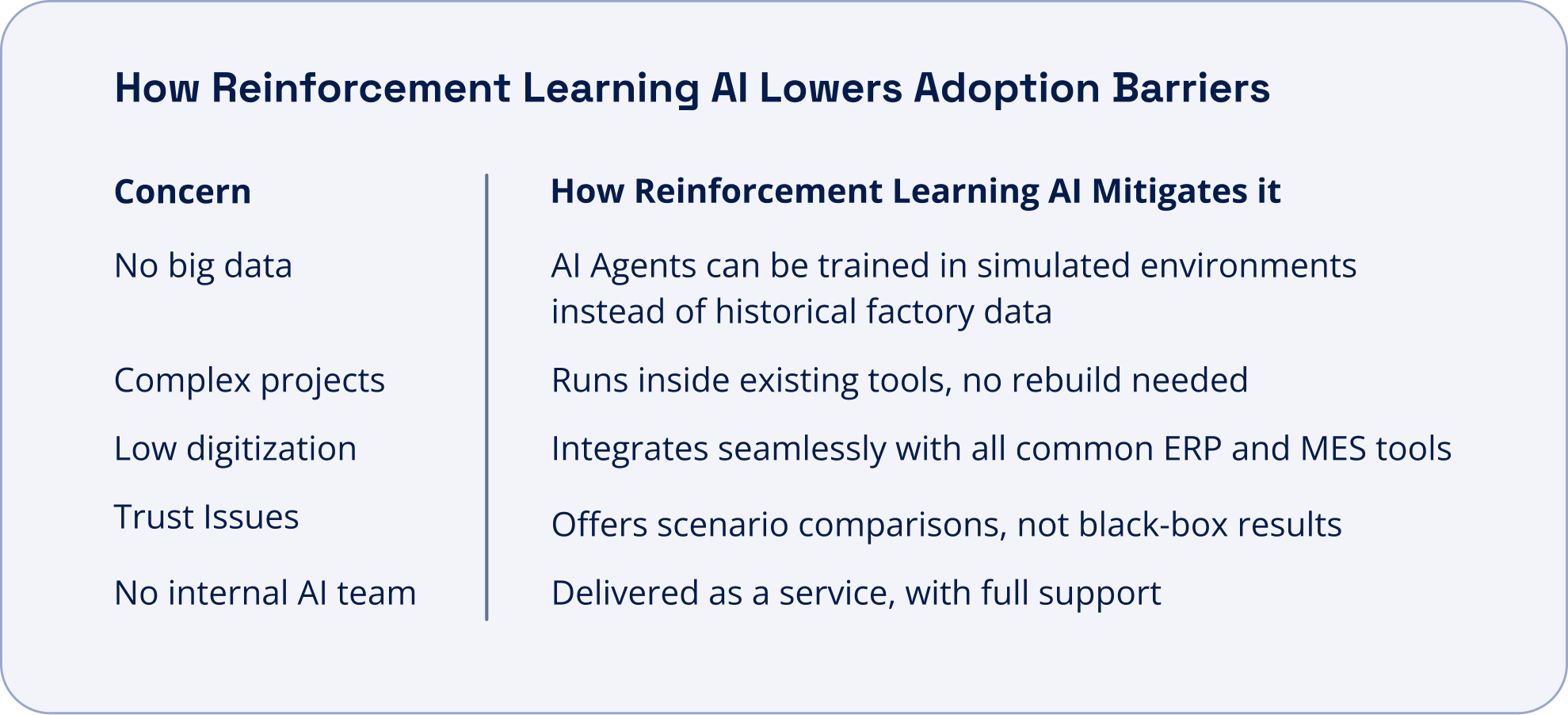
Reinforcement learning-based approaches add another layer. Instead of learning from years of historical data, the AI agent learns scheduling strategies by interacting with a digital twin of your factory and being confronted with thousands of simulated planning scenarios, a method known as reinforcement learning. Through this type of training, this type of AI can deliver strong ROI within a few months, even when historical datasets are thin or processes have recently changed.
Where the ROI of AI-Driven Production Scheduling Shows Up
The ROI of AI-driven production scheduling is ultimately measured in money – either through higher margin on existing revenue or through additional revenue from increased capacity and reliability. Underneath that, several concrete levers drive the ROI of production scheduling AI.
1. Improved on-time delivery and service
Poor schedules lead directly to missed promise dates, partial shipments and penalties. By generating capacity-feasible, constraint-aware plans, production scheduling AI lifts OTD and OTIF metrics. We covered this in detail in in our guide on improving on-time delivery in manufacturing. Industry studies on AI in manufacturing and advanced analytics consistently report double-digit service improvements. Deloitte, for example, finds that smart manufacturing adopters achieve up to 15 % more unlocked capacity and significant gains in reliability.
How this translates into ROI:
- Fewer penalties and chargebacks from key customers
- Lower premium freight and expediting costs
- Higher win rates on new business because promise dates are credible
- Reduced safety stocks because schedules are more reliable
Even a 3–5 percentage point improvement in OTD can justify the ROI of AI-driven production scheduling in high-mix, make-to-order environments where customer relationships are sensitive to reliability.
2. Higher throughput and shorter lead times
AI for production planning can group similar jobs to reduce changeovers, balance bottlenecks and avoid idle time between operations. In practice, this often yields 5–20 % throughput improvements on constrained lines, depending on the baseline. Smart manufacturing surveys show that plants deploying production scheduling AI and related tools report double-digit output gains without adding new machines. By making better use of existing capacity, factories can grow revenue with little or no CapEx.
How this translates into ROI:
- More finished units shipped per week with the same assets
- Ability to accept more rush orders without jeopardizing existing commitments
- Reduced average lead times, which can be a commercial differentiator
If a line producing €500,000 of output per week increases throughput by 10 % via better schedules, that’s roughly €50,000 per week of additional capacity. Over a year, this alone can cover and exceed the production scheduling AI ROI target.
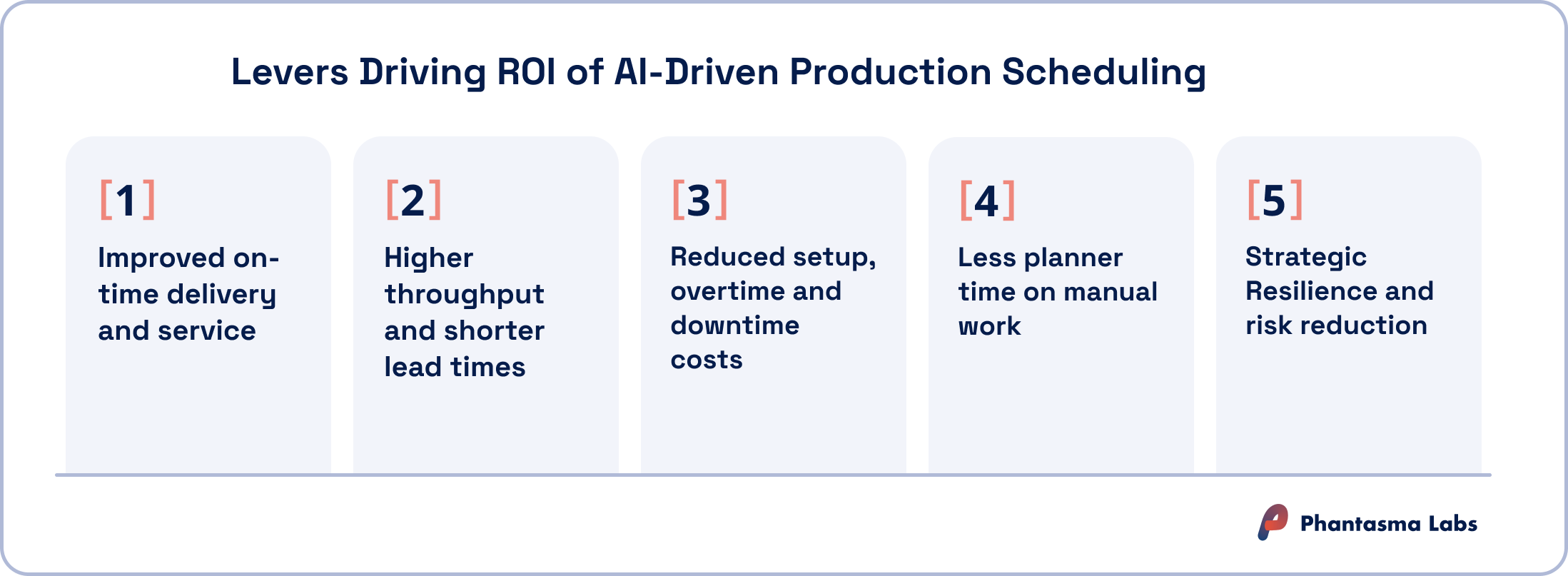
3. Reduced setup, overtime and downtime costs
Every unscheduled changeover, weekend shift or reactive line stop eats into margin. Production scheduling AI attacks these waste categories in three ways:
Setup time: By sequencing similar products together, AI-driven production scheduling reduces changeovers. Many plants see setup time reductions of 10–30 % when moving from manual scheduling to AI-generated sequences.
Overtime: More predictable, optimized schedules smooth utilization across shifts, cutting expensive overtime. Some AI in manufacturing case studies report 10–20 % overtime reductions once planning stabilizes.
Downtime: Faster, smarter replanning after breakdowns or material shortages decreases idle time. When a planner can re-sequence a day’s production in seconds, the line is not waiting for a new plan.
Combined, these savings contribute significantly to the ROI of AI-driven production scheduling, particularly in labour-intensive or high-changeover environments.
4. Less planner time on manual work
Many factories still spend hours each day updating Excel boards, reconciling data from ERP and reacting to emails from sales. With production scheduling AI, much of this manual recomputation is automated.
Planners instead focus on:
- Setting priorities and constraints
- Reviewing AI-generated scenarios
- Communicating decisions to stakeholders
- Driving cross-functional improvements
If a planning team can free up 50-80 % of its time from pure schedule maintenance, this time can be redeployed towards continuous improvement and strategic tasks. The labour cost savings and performance uplift both factor into the ROI of production scheduling AI.
5. Strategic resilience and risk reduction
Finally, the ROI of AI-driven production scheduling includes a resilience component. The ability to run “what-if” scenarios quickly – for example, “What if one key machine is down all next week?” or “What if we pull forward a large order?” – allows leaders to anticipate issues and act early.
In periods of volatility (tariffs, supply shocks, demand swings), this flexibility protects margin and customer relationships. While harder to quantify than direct overtime savings, this resilience is increasingly a board-level concern and often a decisive factor in justifying AI in manufacturing investments. The impact of production scheduling AI is therefore felt not only in day-to-day KPIs, but also in long-term resilience and competitiveness.