Production schedules rarely look the same on Friday as they did on Monday. Planners build a schedule on Monday that reflects what they know: which orders are in, which machines are available, when shifts run. By Wednesday, a rush order has arrived, a supplier missed a delivery, and a machine has been down since Tuesday morning. The schedule is already wrong, and the team is firefighting.
This is the daily reality for most production scheduling teams. The problem isn't that planners are bad at their jobs. It's that the tools most factories use are built for stable environments that no longer exist. Demand changes constantly. A schedule that was valid at 8am can be a liability by noon.
AI production scheduling addresses this directly. Not just by generating plans faster, but by handling the volatility that breaks traditional tools and by helping planners make better decisions when the situation shifts.
Why Production Schedules Break Down When Demand Is Volatile
The triggers are familiar: a priority customer pushes in a rush order, a supplier signals a two-day delay, a key machine goes offline unexpectedly. Any of these, in isolation, might be manageable. But in high-mix manufacturing environments, they can quickly stack.
When plans break down under pressure, planners typically face two options: rebuild the schedule from scratch (which takes hours, during which the factory runs on instinct) or patch the existing plan, creating conflicts that compound over time. Neither is sustainable when this happens every week.
The frequency of these events is increasing. Global supply chain disruptions rose 38% year-over-year in 2024, with close to 80% of manufacturers reporting at least one significant disruption in the past twelve months. The financial exposure is real: unplanned downtime costs mid-sized manufacturing facilities an average of $125,000 per hour, according to Siemens' 2024 True Cost of Downtime report.
The core issue isn't that disruptions happen. It's that most scheduling tools aren't designed to respond to them without significant manual effort.
Static vs. Dynamic Production Scheduling: What's the Difference?
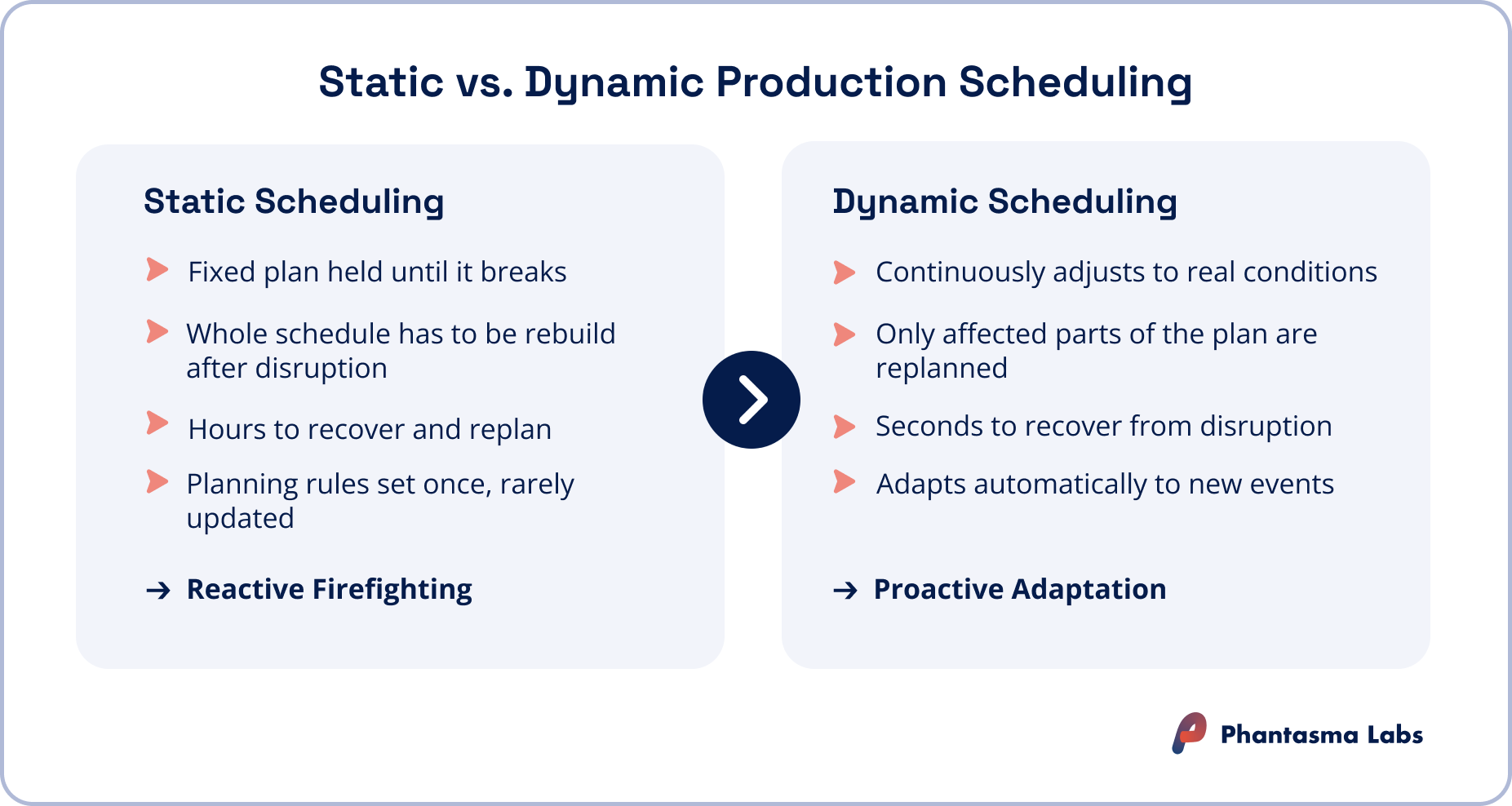
Static scheduling creates a plan and holds it until it breaks. The planner defines constraints, sequences jobs, and publishes a schedule to the shop floor. When reality changes, the plan doesn't update automatically. Someone has to intervene.
Dynamic production scheduling works differently. Instead of producing one fixed production sequence, a dynamic scheduler continuously evaluates the current state of the factory and adjusts the plan in response to real-time events such as machine failures, rush orders, and supply delays. When conditions change, the system doesn't wait for the next planning cycle. It recalculates and proposes an updated sequence.
This distinction matters most in high-mix environments: factories producing many different products with varying routings, sequence-dependent setups, and shifting customer priorities. In these settings, static approaches hit their limits quickly. A rule set that worked last month may not reflect what the bottleneck looks like today.
How AI Handles Disruptions Differently Than Legacy Tools
Traditional Advanced Planning and Scheduling tools rely on fixed rules and batch recalculation. When something disrupts the plan, they typically rerun the full scheduling algorithm from scratch, which is computationally slow and often produces a result that looks very different from what was on the shop floor minutes before.
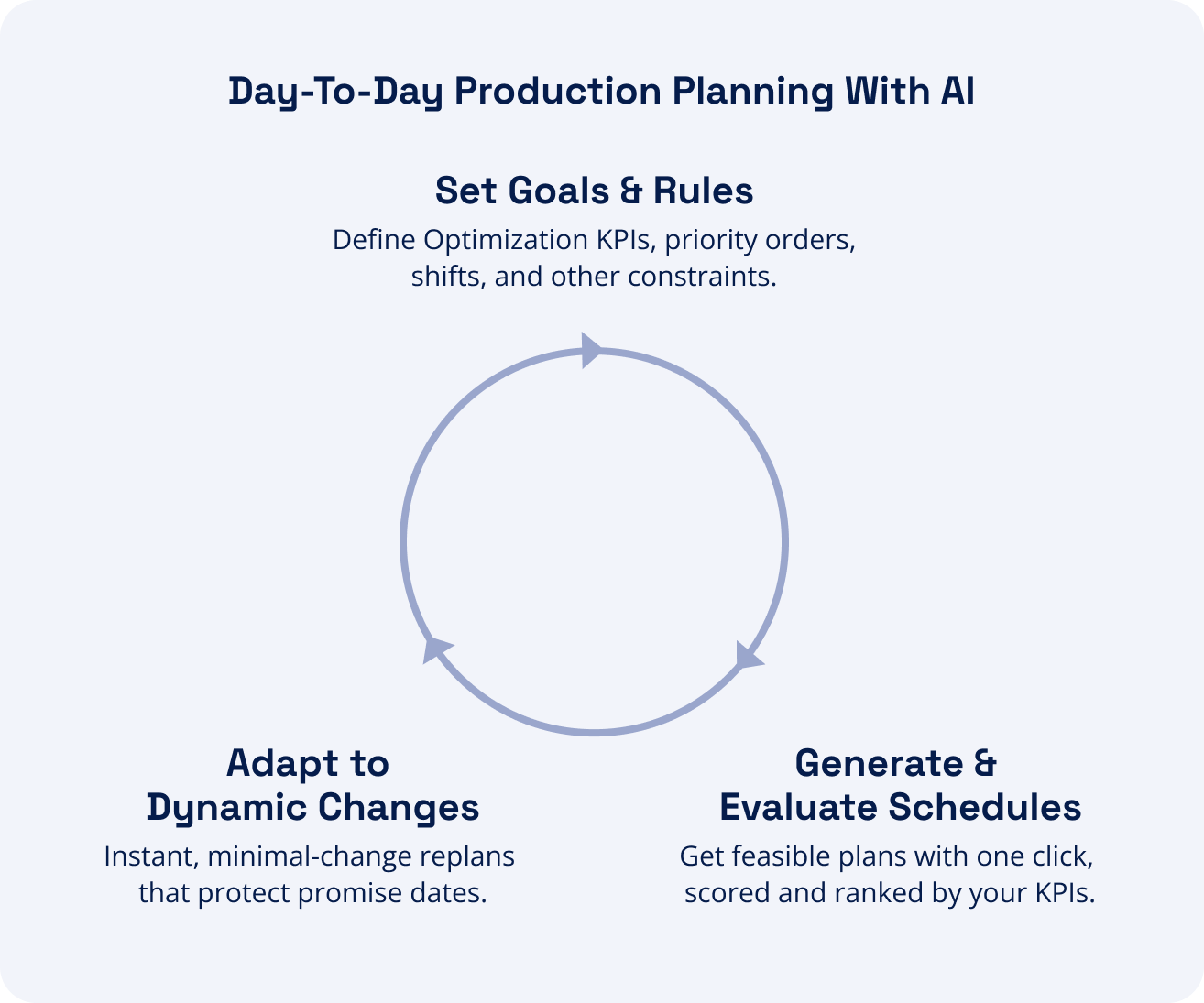
AI production scheduling takes a different approach. Instead of recalculating everything, a well-designed AI system identifies which parts of the schedule are actually affected by a disruption and replans only those, keeping the rest of the plan stable. This is what makes real-time replanning practical rather than theoretical.
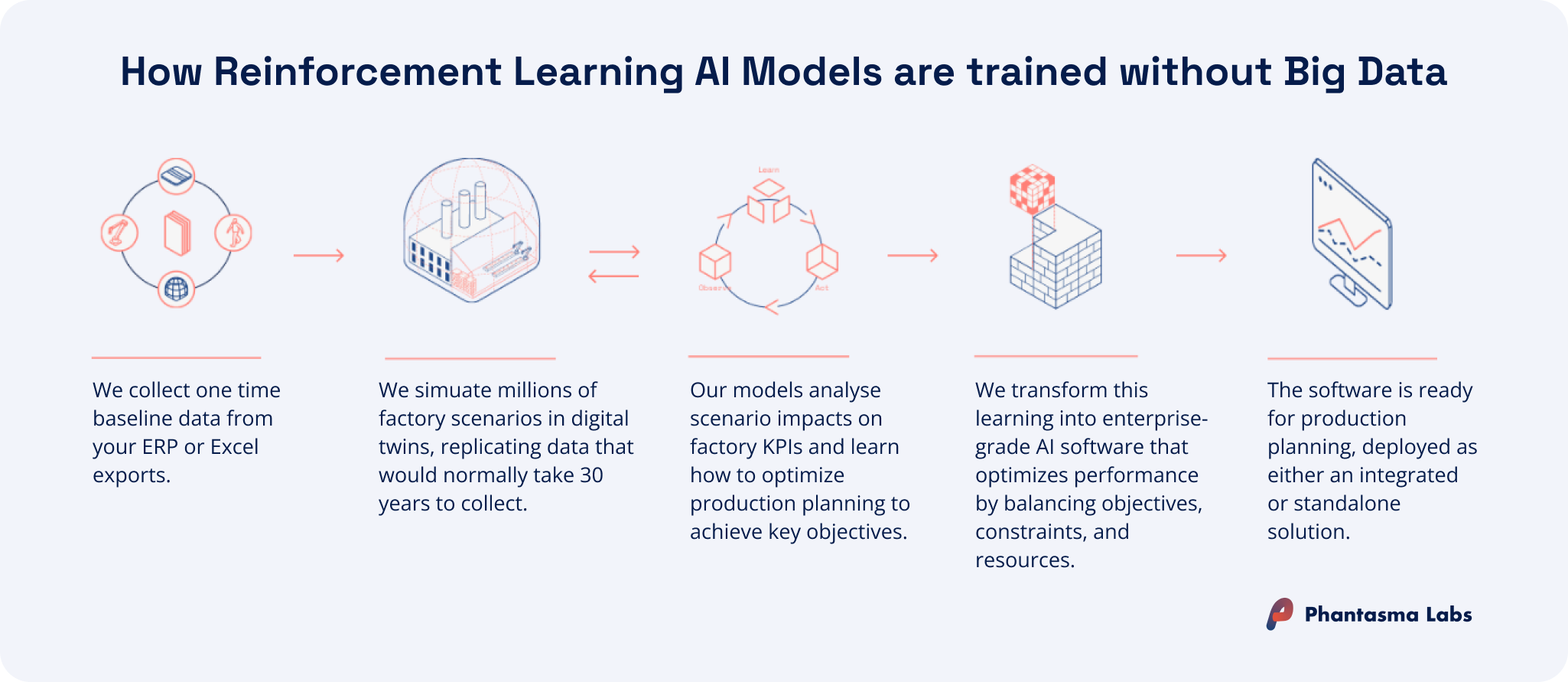
The most effective AI scheduling tools use reinforcement learning (RL) to develop scheduling policies. Unlike classical optimization, which solves for one snapshot at a time, RL trains an agent across millions of simulated scenarios including machine breakdowns, rush orders, and staffing shortages, until it learns to handle a wide range of situations without needing to have seen each one before. It is also the approach Phantasma's own scheduling AI technology is built on. A comprehensive review in the Journal of Intelligent Manufacturing confirmed that RL-based approaches consistently outperform traditional dispatching rules and classical optimization methods in dynamic job shop environments, particularly under conditions of frequent disruption.
The practical result is a new, constraint-aware schedule in seconds rather than hours. The planner sees a minimal-change update that keeps as much of the existing plan intact as possible while resolving the disruption.
Scheduling Efficiency vs. Scheduling Effectiveness: Why AI Improves Both
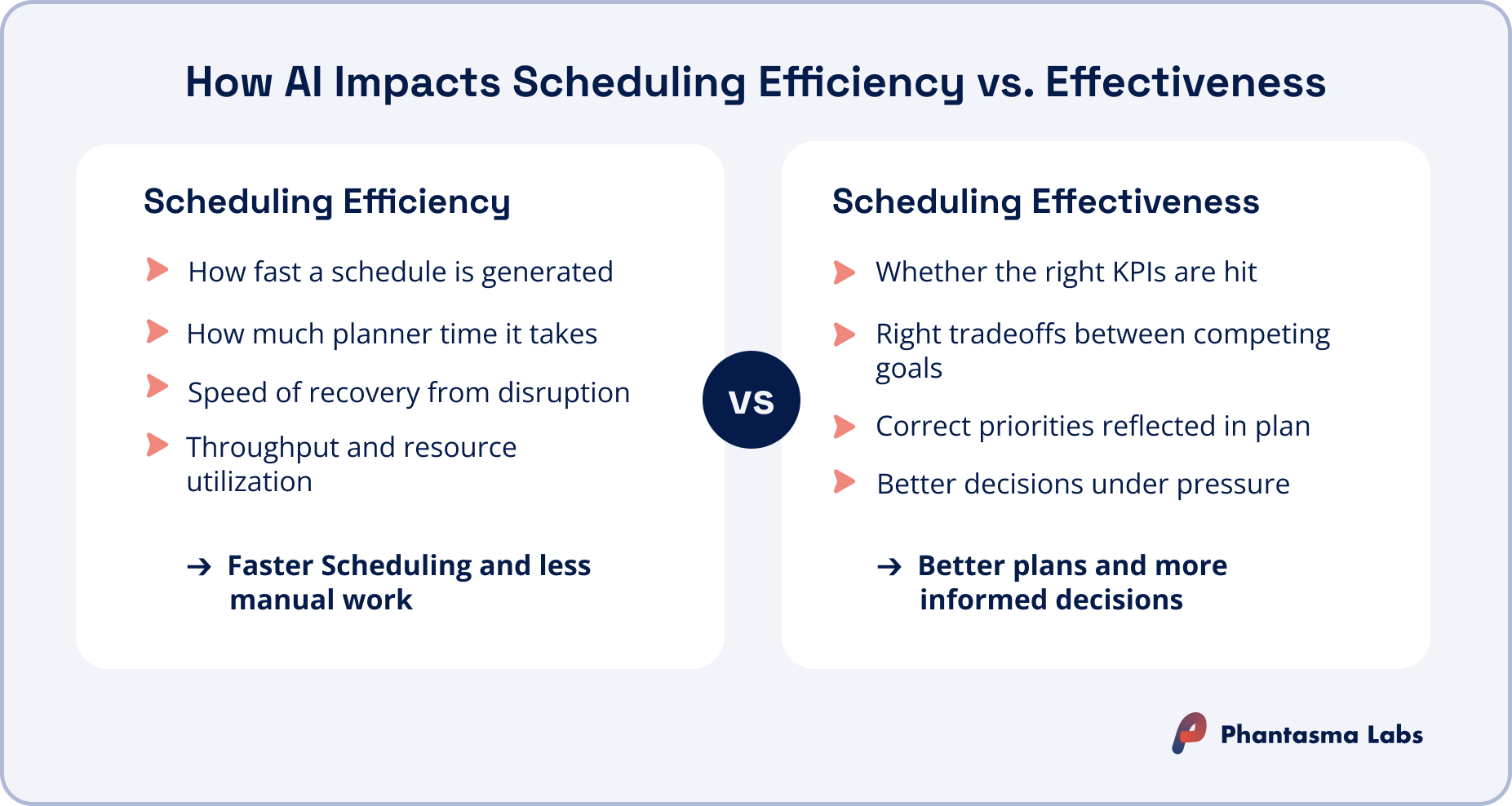
Most conversations about AI in production scheduling focus on speed: how much faster schedules are generated, how much less time planners spend on manual work. These gains are real. But focusing only on efficiency misses half the picture.
Scheduling efficiency is about inputs: how long it takes to produce a plan, how much planner time it consumes, how quickly the system recovers from a disruption. Scheduling effectiveness is about outputs: whether the plan reflects the right priorities, whether tradeoffs between competing KPIs are being made well, and whether the factory is optimizing for what the business actually needs.
Manual scheduling under pressure almost always compromises effectiveness. When a planner has thirty minutes to rebuild a schedule after a machine breakdown, they are optimizing for speed and feasibility, not for the combination of on-time delivery, changeover minimization, and bottleneck utilization that the business requires. There is no time to evaluate alternatives.
AI production scheduling improves both dimensions simultaneously. It generates plans faster and it generates better plans: ones that weigh multiple competing constraints at once rather than falling back on rules of thumb. Companies using AI-driven, agile scheduling approaches report 30% less production downtime during disruptions compared to traditional scheduling methods. AI scheduling tools built on reinforcement learning and simulation training achieve 30-40% better schedule quality compared to conventional optimization approaches, based on independent benchmarks across manufacturing environments.
To estimate the potential ROI for your factory, it helps to look at both levers: the time savings on the efficiency side and the KPI improvements on the effectiveness side.
Scenario Planning and Real-Time Decision Support
One of the most practical capabilities of AI production scheduling, and one that gets less attention than it deserves, is what-if analysis. When a planner faces a decision under pressure (accept a rush order or protect an existing commitment? run a weekend shift or let the bottleneck slip?), they usually have to make that call with incomplete information. The schedule doesn't show what the downstream consequences will be. Planners have to estimate based on experience.
AI scheduling tools with scenario planning capability change this. A planner can test an alternative before committing: what happens to throughput and on-time delivery if we accept this order? What if machine 3 is down until Thursday? The system evaluates each scenario against the factory's KPIs and shows the tradeoffs transparently.
This turns scheduling from a reactive task into a proactive one. Instead of updating the plan after something has gone wrong, planners can anticipate problems before they hit the shop floor, communicate realistic timelines to sales and operations, and make decisions based on evidence rather than instinct.
What AI Production Scheduling Needs to Get Started
One of the most common concerns about AI in manufacturing is that it requires years of historical data and significant infrastructure investment. For production scheduling AI, this is largely a misconception.
Modern AI scheduling tools, particularly those based on reinforcement learning, train in simulation rather than on historical factory data. The agent learns scheduling strategies by interacting with a simulated model of the factory, running through millions of scenarios before a single real job is scheduled. No years of clean production records are required.
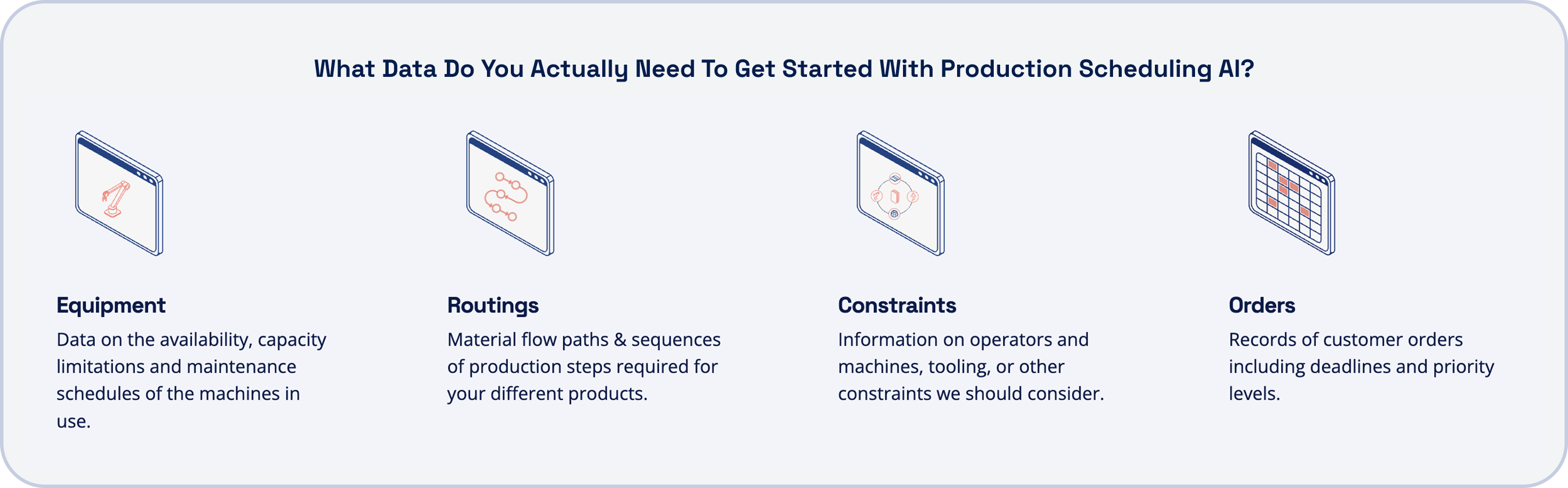
The data requirements are straightforward and typically already available in the ERP or MES: orders (quantities, due dates, priorities), routings (operations, setup and run times, allowed machines), resource calendars (shifts, maintenance windows, holidays), and basic planning rules (freeze windows, WIP limits, sequencing constraints). This is enough to build a working, capacity-aware schedule.
Integration follows the same read-write pattern used in any scheduling system: pull data from ERP or MES, generate the optimized schedule, push the approved plan back to execution. No existing systems need to be replaced. A typical deployment takes four to six weeks.
From Reactive to Adaptive: What AI Production Scheduling Actually Changes
AI production scheduling doesn't eliminate disruption. Factories will always face rush orders, machine breakdowns, and supply chain surprises. What it changes is how effectively those disruptions are handled.
The real value isn't just speed. It's the ability to replan targeted parts of the schedule in seconds, to evaluate the consequences of decisions before committing to them, and to optimize for the right KPIs, such as on-time delivery, throughput, and setup time, rather than just generating something feasible under pressure.
For production scheduling teams, this means less time spent firefighting and more time making decisions that actually improve performance. The shift from reactive to adaptive scheduling is where the measurable gains show up: in delivery reliability, in planner capacity, and in how the factory handles the next disruption.
Key Takeaways
Production schedules break down under volatile demand when tools aren't designed for real-time change. Supply chain disruptions rose 38% in 2024, and close to 80% of manufacturers reported at least one significant disruption in the past year.
Dynamic production scheduling continuously adjusts plans as conditions change, rather than holding a fixed sequence until it fails.
AI handles disruptions differently than legacy APS tools: by replanning only what's affected rather than rebuilding from scratch, in seconds rather than hours.
The efficiency gains (faster scheduling, less manual work) and effectiveness gains (better decisions, right KPIs) both matter. AI production scheduling improves both simultaneously.
Scenario planning turns scheduling from reactive to proactive: planners can test alternatives and see the tradeoff consequences before committing.
Starting requires less data than most factories expect. Orders, routings, resource calendars, and basic planning rules from existing ERP or MES systems are typically sufficient.
FAQs on this Topic
What's the difference between static and dynamic production scheduling?
Can AI actually replan in real-time after a machine breakdown or a rush order?
What's the difference between scheduling efficiency and scheduling effectiveness?
How does what-if scenario planning work in AI scheduling tools?
FREE AI PLAN PREVIEW
See your production schedule, rebuilt by AI
Send us a small sample of your data and see the optimized schedule our AI would build for your factory.
Get a monthly wrap up of the latest news and industry trends combined with deep dives and practical guides around industrial AI, production planning and smart manufacturing.
Thanks for subscribing! We’ll keep you up to date with monthly insights on smart manufacturing.
Oops! Something went wrong while submitting the form.