ChatGPT can draft an email, summarize a forty-page report, or answer a technical question in seconds. So why not schedule a factory?
It's a reasonable question. Language models have become the most visible form of AI, and they're genuinely useful across a huge range of tasks. But production scheduling is a very different kind of problem. It isn't about generating a plausible answer. It's about finding a plan that works across machines, shifts, routings, shared tools, operator skills, due dates, and competing priorities, all at the same time.
That's where the broad label “AI” can get confusing. A language model like ChatGPT and an AI system built specifically for production scheduling can both be called AI, but they are designed for very different jobs and learn in very different ways.
When a vendor says its scheduling tool is “AI-powered,” that distinction matters. The question isn't whether it uses AI. It's what kind of AI is behind it, what it has been built to do, and whether it can reliably make production decisions under real factory constraints.
That's the difference we'll break down in this article.
So what actually counts as "AI"?
The AI category is broader than many people realize. A large language model like ChatGPT, Gemini, or Claude, an optimization engine that solves scheduling problems, a computer vision system that detects defects on a production line, and a reinforcement learning agent are all described as AI. Even within production scheduling software alone, several different kinds of AI sit behind the label. What separates them is how they reason, what they were trained on, and what they can reliably do.
Language models are trained on vast amounts of text to be useful across a wide range of tasks. That versatility is exactly what makes them so powerful for everyday knowledge work. But production scheduling is a different kind of problem. It requires a system that can work with the specific constraints, dependencies, and objectives of a factory and turn them into an executable production sequence. The differences matter most when the output is a production sequence someone is going to run their factory on.
There's nothing wrong with a language model. The problem starts when you expect it to do a job it was never designed for, the kind of job a purpose-built system exists to handle.
.png)
Where do ChatGPT and Claude actually help on the shop floor?
Tools like ChatGPT and Claude are good, sometimes very good, at the work around production rather than production itself. Give one your standard operating procedures and it can answer a technician's question in seconds instead of sending them digging through a binder. Ask it to draft a shift handover, summarize a maintenance log, or pull the relevant passages out of a forty-page supplier spec, and it saves real time. That kind of knowledge work is exactly what language models are designed for.
The limit appears when you ask for operational decisions under real constraints. A language model doesn't inherently have an operational model of your factory: your current order book, machine calendars, routing constraints, shared tools, or operator availability. Ask ChatGPT to sequence next week's production and it can give you a confident, well-written answer. But it wasn't built to turn all of those interdependent constraints into a production sequence you can reliably execute.
Two structural characteristics of language models make this gap significant for any serious manufacturing use. First, they can generate outputs that sound accurate but are factually wrong, a well-documented limitation that's manageable when you're drafting text but not when a wrong sequence cascades into late orders and overtime. Second, the same input can produce different outputs at different times, so decisions aren't reproducible. A production environment needs consistent answers it can build a routine around.
What does industrial AI for production scheduling actually do?
Vendors rarely spell this part out. Building AI for production scheduling doesn't mean using a more powerful or more specialized version of ChatGPT. It's a different kind of system entirely, designed around how production scheduling actually works on a real factory floor.
In a factory, everything depends on everything else. Setups depend on sequence, machines share tooling, and operators have skills that don't overlap. A rush order for one customer quietly pushes three others toward the edge of their delivery window. AI built for this has to hold all of that at once, see how one decision affects the next, and apply that understanding the same way every time. That's the key difference: a language model is built to work across a huge range of language and knowledge tasks. Industrial AI for scheduling is built around one specific problem: making production decisions under real factory constraints.
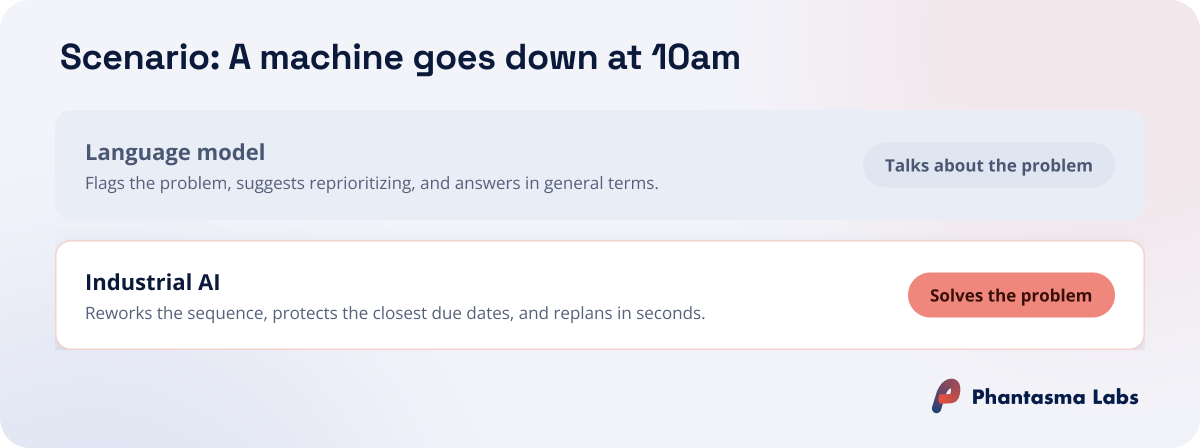
Picture a machine going down at ten in the morning. Ask a language model and it can tell you that's a problem, and suggest, in general terms, that you reprioritize. A system built for production scheduling does the actual work: it reschedules using alternative routes on the machines still running, protects the orders closest to their due dates, shifts the ones that can absorb a delay, and provides a revised plan in seconds. Same event, two completely different kinds of help.
Consistency is the part that's easy to underrate here. A system that gives a useful answer on Monday but a different answer to the same problem on Thursday is difficult to build a reliable planning process around. On a shop floor, that kind of consistency matters.
This is where purpose-built industrial AI comes in. Phantasma's production scheduling model is developed specifically for factory environments and the decision logic they require, rather than adapted from a general-purpose foundation model.
Understanding isn't enough. Can it show you why?
Understanding your factory is the first requirement. The second is one the industry is only starting to take seriously. If an AI reshuffles your week and pushes a job you thought was urgent to Friday, you need to know why. The more a decision matters, the more a planner needs to see the reasoning before acting on it. In practice that means the system should be able to tell you something a planner can actually check: this job moved because the machine it needs is down until Thursday, and holding it there protects your three highest-priority deliveries.
On a shop floor, a recommendation nobody can explain is a recommendation planners will struggle to trust. Planners have spent years learning what their factory can and can't do, and they're right to be wary of a system that overrules them without a reason. Researchers call it algorithm aversion. Accuracy alone doesn't solve that. Planners also need visibility into why a decision was made. When they can follow the logic behind a recommendation, they have a much better basis for deciding whether to act on it. When they can't, they quietly go back to the spreadsheet.
Explainable AI in manufacturing isn't fully solved yet, though the field is making real progress on it, and any vendor who claims it's completely figured out is overselling. It's a direction worth pushing hard on, because in a factory the reason behind a decision is what lets a planner stay in control instead of handing it to a black box.
Two kinds of AI, two different jobs
The better way to think about this isn't ChatGPT versus "real AI," as if one were fake. They do different jobs. Language models handle language and knowledge work, helping people find things, draft things, and understand things faster. Purpose-built operational AI handles decisions under real constraints, the sequencing, the replanning, and the trade-offs that decide whether Thursday's shipments go out on time. A factory can use both well, and the mistake is expecting the first to do the second, or paying for the second and getting the first with a nicer interface. There's a useful overview of where different types of AI have generated real results in manufacturing if you want a broader view of where each fits.
What should you ask before trusting an AI with a production decision?
Evaluating AI for production planning doesn't require deep technical knowledge. It requires asking clear questions and expecting clear answers.
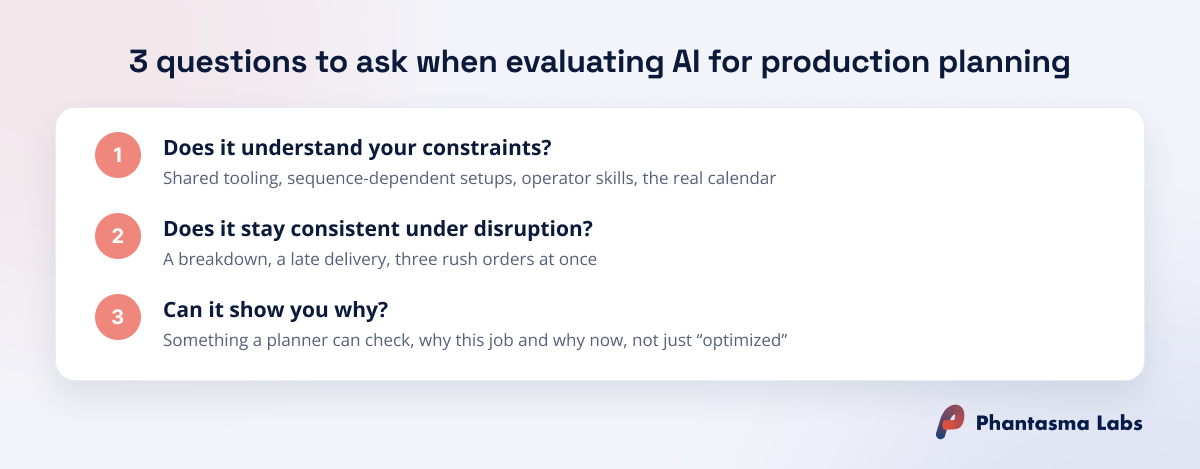
Does the system actually understand your real constraints, the shared tooling, the setups that depend on sequence, the operator skills, and the real calendar, or is it working from a simplified version of your factory that breaks down in real conditions? Ask the vendor to walk you through how the system models your environment specifically, not in general.
When things change, does it stay consistent? A machine breakdown, a late delivery, three simultaneous rush orders: these are the moments that decide whether AI for production planning earns its place. Ask for evidence of how the system handles disruption, not just what it does in ideal conditions.
And can it give you a reason you can check, at least on the decisions that matter? Not a dashboard that just says "optimized," but something a planner can follow: why this job, why now, what would change the answer. Full transparency is still an evolving area across the field, so look for a vendor who's honest about where their explainability stands, not one who claims it's fully solved. And if the answer sounds like a description of ChatGPT's capabilities, it's the wrong tool for this job.