Most production planners know what advanced planning and scheduling (APS) is, or have at least encountered it. APS tools emerged as a genuine improvement over spreadsheets and basic ERP scheduling modules: they introduced finite capacity logic, respect for routing constraints, and the ability to model a factory's real production environment. For many manufacturers, APS software remains the backbone of daily planning.
But over the past few years, AI-based production scheduling has emerged as a distinct category — not simply an upgraded version of APS, but a different approach to how scheduling logic is built and how it responds to change. The question for most factory teams isn't whether to abandon what's working, but to understand what the actual difference is, and under what conditions one approach outperforms the other.
This article explains both approaches clearly, compares them head to head, and offers a practical framework for deciding which fits your factory.
What Advanced Planning and Scheduling Does and Why It Was a Step Forward
Advanced planning and scheduling refers to a class of software tools designed to generate production schedules that respect real-world manufacturing constraints. Unlike the infinite capacity planning built into most ERP systems (which assigns work without checking whether machines are actually available) APS introduced finite capacity scheduling. It accounts for machine hours, shift calendars, routing sequences, and setup times to produce schedules that are theoretically achievable.
Most APS systems use operations research (OR) methods at their core: constraint programming, linear programming, mixed-integer programming (MIP), or rule-based heuristics. These algorithms evaluate a defined set of possible sequences and find a feasible, near-optimal plan within that set. For manufacturers with stable production environments — predictable demand, limited product mix, few disruptions — this delivers reliable value. Plans are constraint-aware, lead times are more accurate, and planners spend less time reconciling the schedule with physical reality.
Where Advanced Planning and Scheduling Reaches Its Limits
APS performs well within the boundaries it was designed for. Those boundaries become visible in specific manufacturing environments.
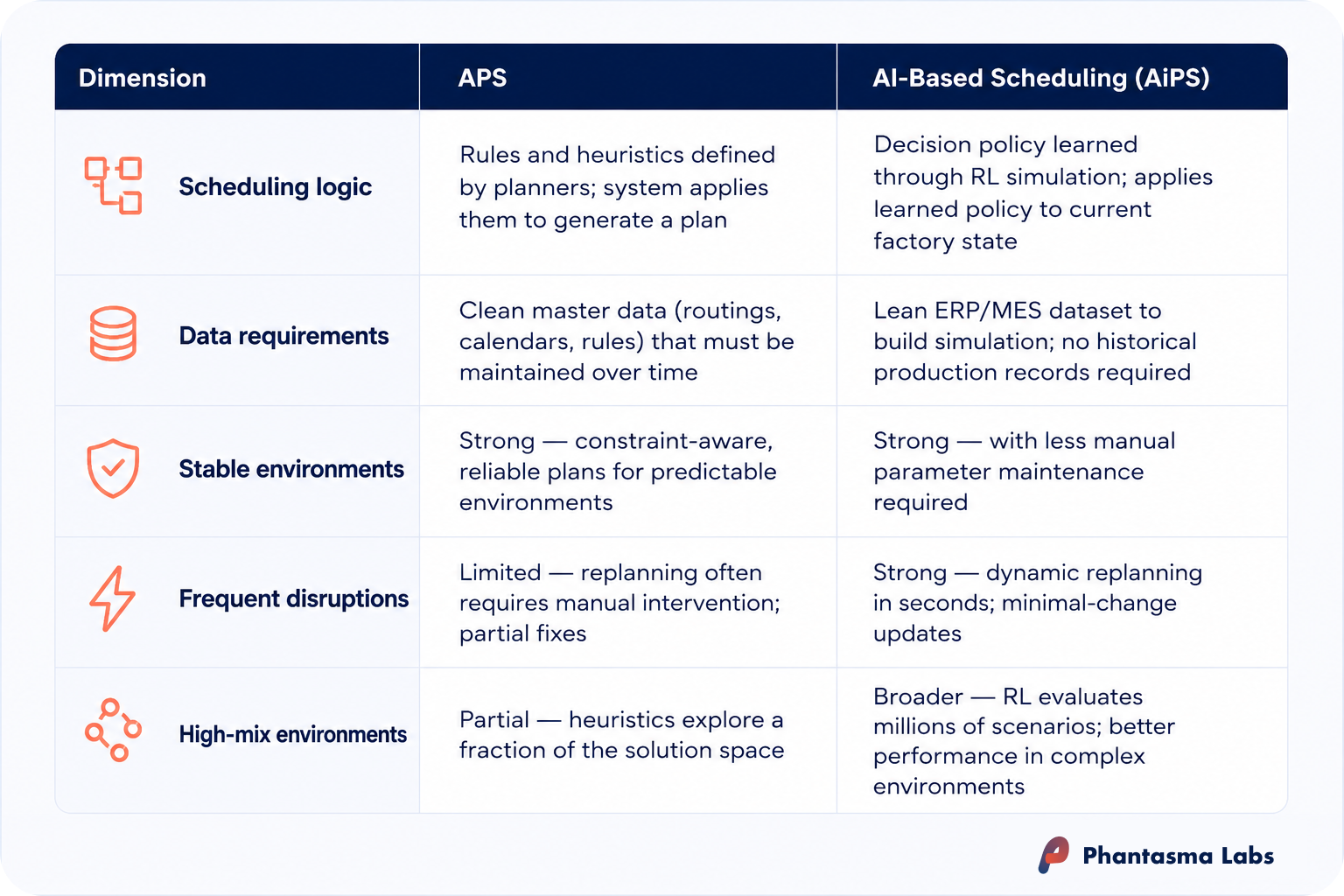
The core constraint of most APS systems is that their scheduling logic relies on rules and parameters that planners define and maintain. Routings, setup times, capacity rules, priority logic — all of this must be configured and kept accurate. In factories where products, machines, or processes change frequently, keeping APS master data current is a significant ongoing effort. As McKinsey notes, one of the most common reasons advanced planning and scheduling systems underperform expectations is the gap between how the system is configured and what's actually happening on the floor.
.png)
A second limitation is solution quality in complex environments. APS heuristics explore a fraction of the total solution space, and as the Wikipedia entry on APS notes, the solution space grows approximately factorially with the number of jobs and machines. For low-mix, high-volume lines, this is rarely a problem. For high-mix environments with sequence-dependent setups, the gap between what APS finds and what's actually optimal can be significant.
The third limitation is disruption handling. When a machine breaks down or a rush order arrives, most APS systems require the planner to manually trigger replanning. The system reruns its algorithm, but it doesn't necessarily minimize the ripple effect across the entire schedule. In factories where disruptions are frequent, planners often end up manually patching the schedule rather than relying on APS software to replan effectively.
How AI-Based Production Scheduling Works Differently
The fundamental difference between APS and AI-based production scheduling lies in how the scheduling logic is built.
APS relies on rules and algorithms defined by humans. The system applies those rules to generate a plan. AI-based production scheduling, by contrast, learns a decision policy through experience. Specifically, modern AI schedulers use reinforcement learning (RL): an AI agent runs millions of simulated production scenarios in a digital model of the factory, trying different sequencing strategies and receiving feedback based on KPI outcomes like on-time delivery, setup time, throughput, and others. Over time, the agent develops a scheduling policy that generalizes across a wide range of production situations.
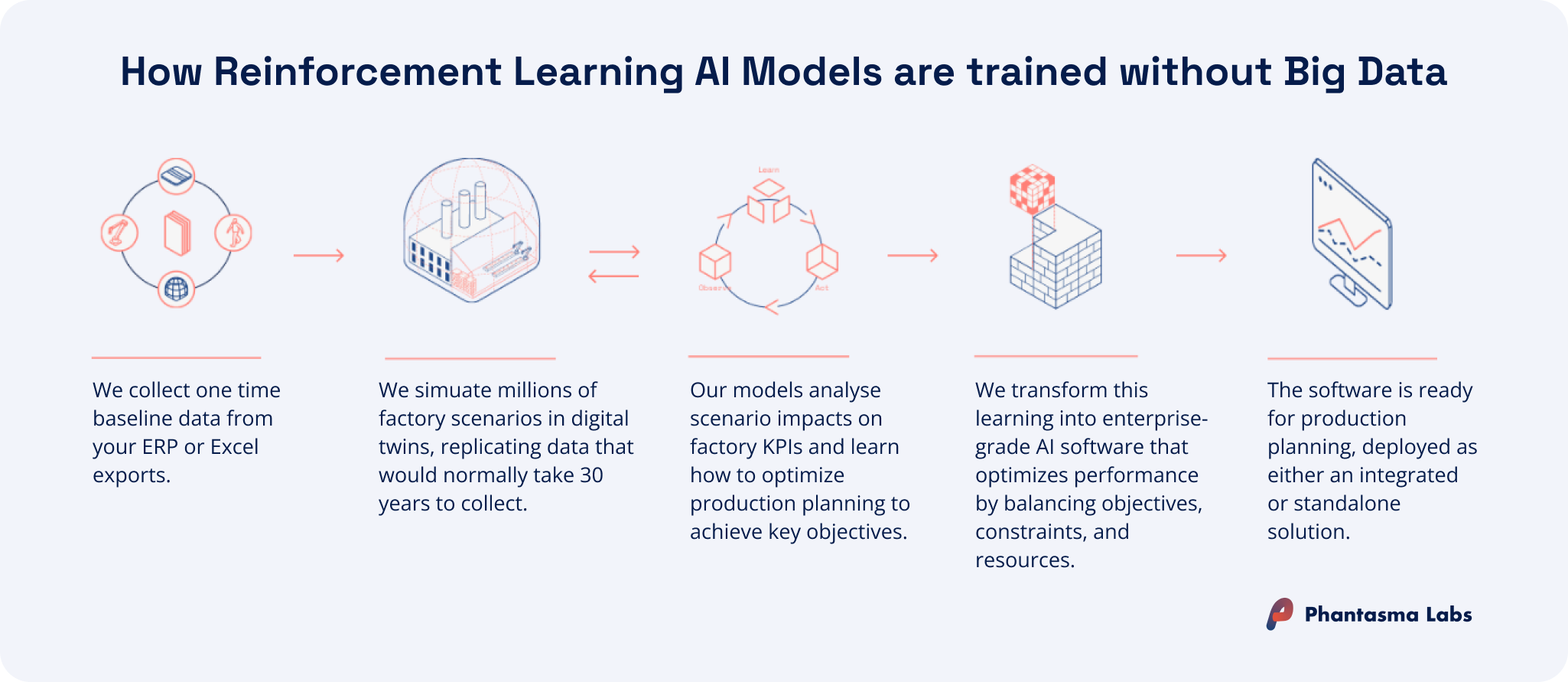
One practical implication of this approach is that no historical production data is required. The agent learns in simulation, not from past records. This makes AI-powered planning and scheduling accessible to factories that don't have years of clean, structured data, which is the reality for most mid-market manufacturers. A lean dataset from the ERP or MES (orders, routings, machine calendars, shift models) is sufficient to build the simulation environment.
The second implication is dynamic replanning. Because the agent has learned to schedule across millions of simulated disruption scenarios, it can respond to a machine breakdown or a rush order by applying that learned policy to the current factory state, generating a minimal-change update in seconds rather than requiring manual intervention.
On AiPS: Some vendors, including Phantasma Labs, use the term AiPS (AI-based Production Scheduling) to describe this class of tools — distinguishing simulation-trained, RL-based schedulers from classical APS systems. More on the underlying approach is available on their technology page.