Most OTD problems start in the schedule, not the shipment. Learn how finite capacity planning, schedule adherence, and faster replanning drive on-time delivery in manufacturing.
On-time delivery is the metric your customers actually experience. Internal production performance counts for nothing if the order arrives late. Yet most efforts to improve on-time delivery in manufacturing focus on the wrong place: better logistics, faster shipping, real-time machine dashboards.
The root cause of most missed delivery dates isn't at the shipping dock. It's in the production plan, often days or weeks before the first item ships. This article explains what on-time delivery actually measures, why schedule quality is one of the primary drivers, and what manufacturers can do to improve it consistently.
What On-Time Delivery Means and How to Measure It
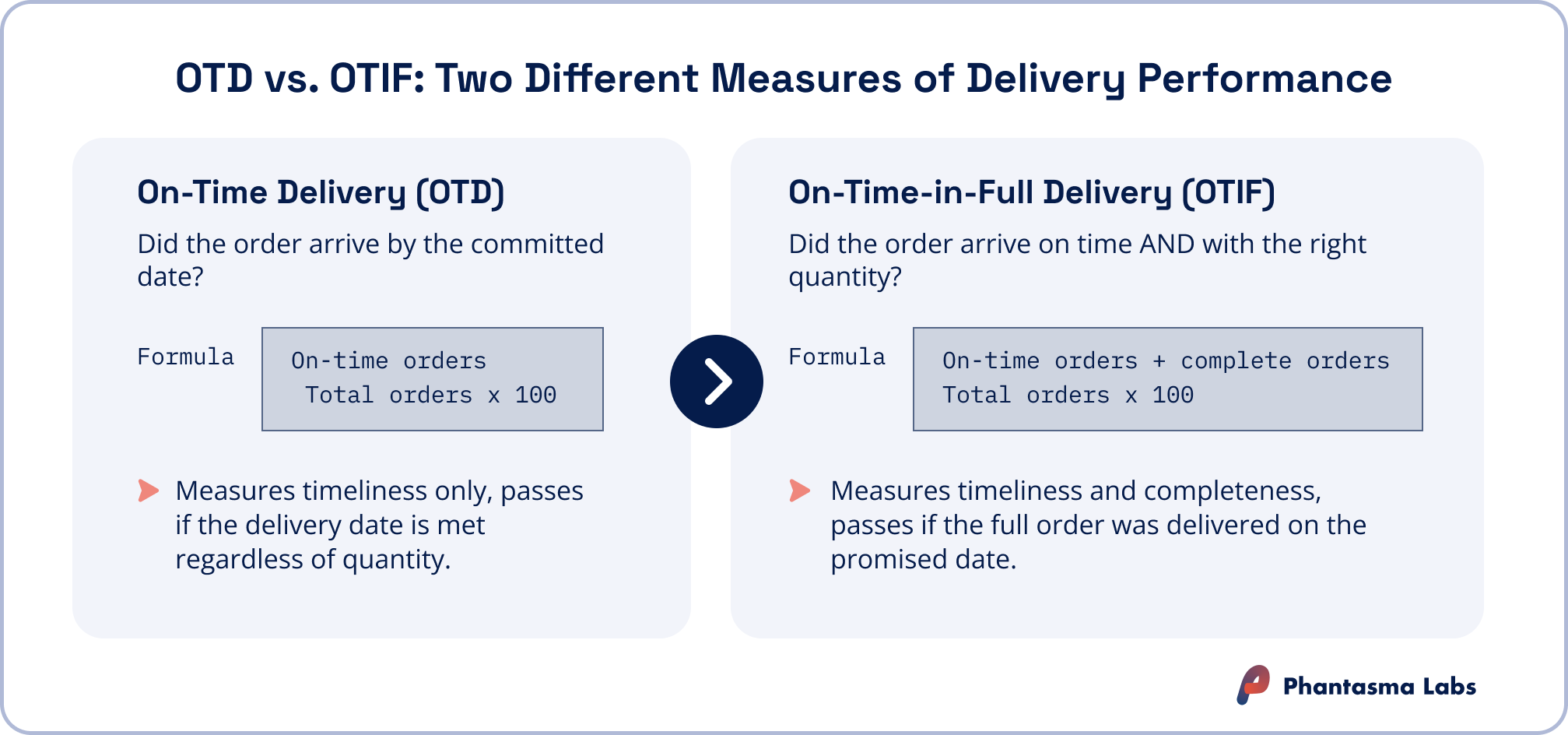
On-time delivery (OTD) measures the percentage of orders that reach the customer by the agreed delivery date. The formula is straightforward:
OTD (%) = Orders delivered on time ÷ Total orders shipped × 100
One distinction worth drawing early: OTD measures timeliness only. It doesn't capture whether an order arrived complete. That's what OTIF (on time in full) covers. A shipment that arrives on the correct date but 10 units short counts as on-time delivery but fails OTIF. Both metrics matter; they measure different things.
What counts as on time should always be defined by the date committed to the customer, not an internal planning target or an optimistic estimate given at order entry.
Why OTD Problems Usually Start in the Schedule, Not the Shipment
On-time delivery is a lagging indicator. By the time a delivery is late, the decision that caused it often happened days or weeks earlier, in the schedule.
Three scheduling factors account for the majority of missed delivery dates:
1. Plans built on unrealistic capacity assumptions: most ERP systems plan without checking whether machines are actually available at the time work is assigned. A plan that looks feasible on screen but cannot physically be executed will generate late orders reliably.
2. The inability to replan fast enough when disruptions hit: Machine breakdowns, rush orders, and operator absences happen in every factory. The critical question is how long it takes to rebuild the schedule afterward. If replanning takes two or three hours, a single disruption can push multiple orders past their due dates before anyone has a revised plan.
3. High-mix complexity: Factories running many different product types face compounding constraints: sequence-dependent setups, competing priorities, and bottleneck interactions that make a plan fall apart faster than planners can manually correct it.
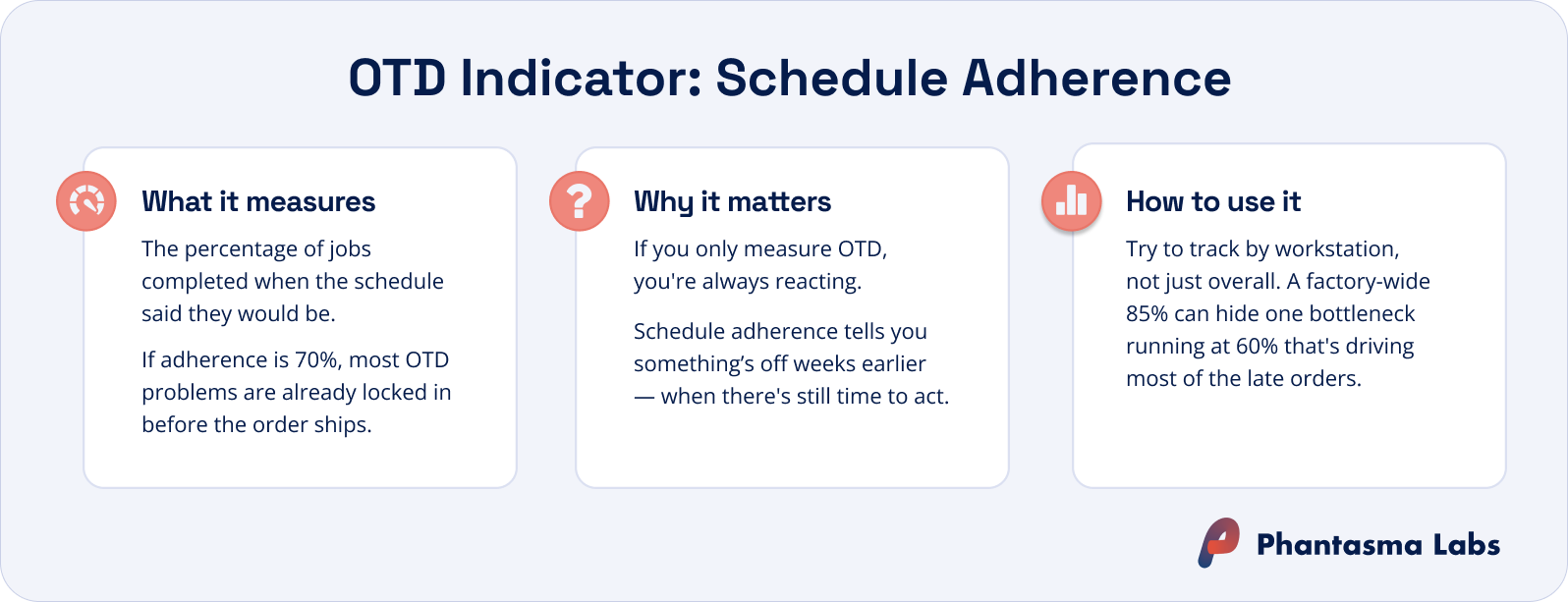
Schedule adherence, meaning how closely the shop floor executes what the schedule says, is the leading indicator of OTD performance. If adherence is running at 70%, on-time delivery will follow. Improving on-time delivery in manufacturing means fixing what happens upstream, not managing the consequences downstream.
The Most Common Causes of Poor On-Time Delivery
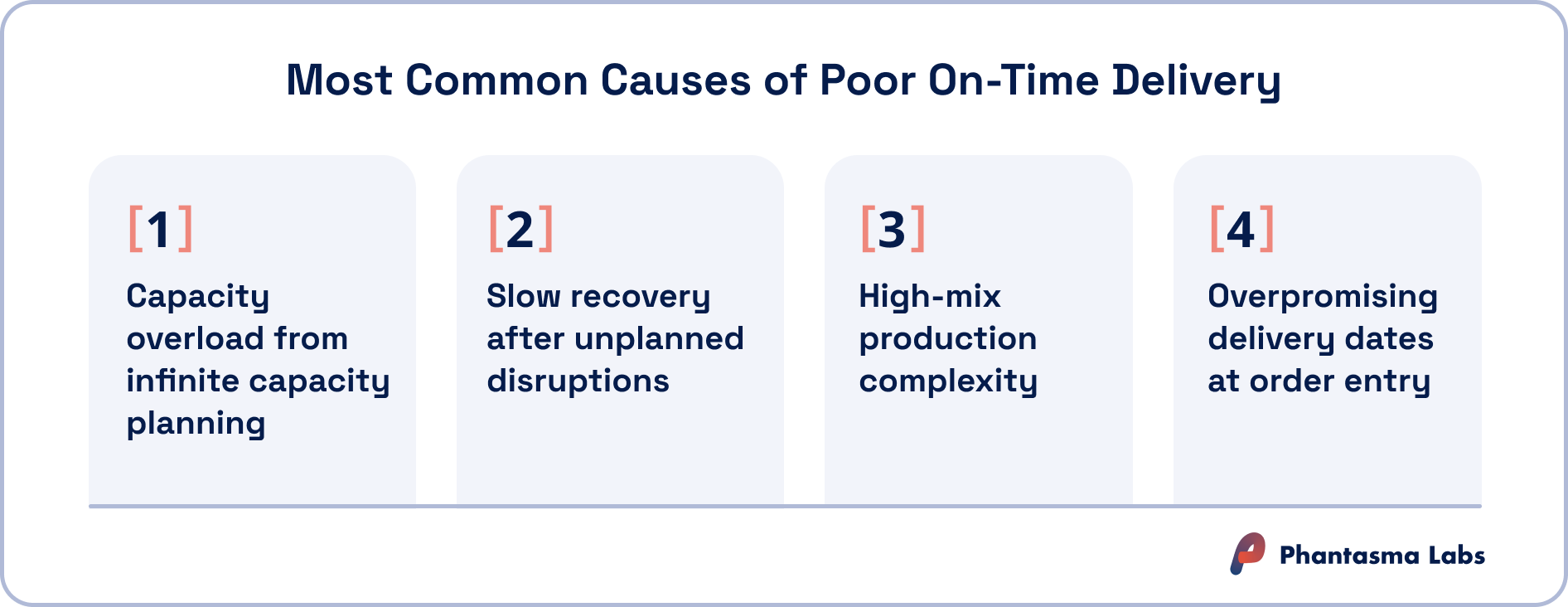
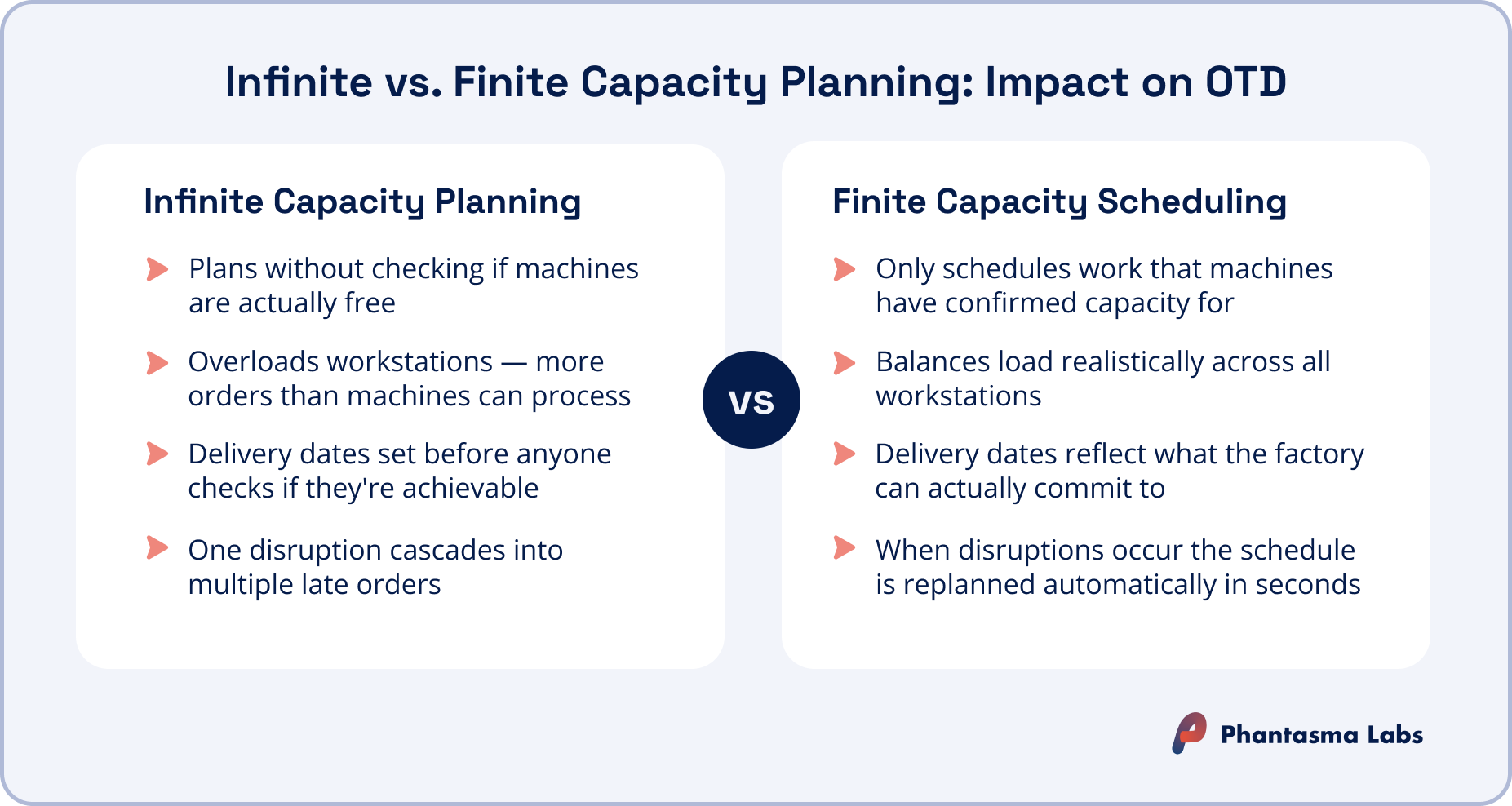
Capacity overloading from infinite capacity planning. Most standard ERP systems generate schedules without verifying real machine availability, a practice known as infinite capacity planning. The system assumes resources can absorb any workload regardless of actual shifts, maintenance windows, or orders already in the queue. The result is a schedule that assigns more work to a machine than it can physically complete. Promised delivery dates are unrealistic before production begins.
Slow recovery after disruptions. When a machine breaks down or a priority order arrives, the production plan has to change. In manual environments, rebuilding the schedule can take hours. During that window, lower-priority orders continue accumulating delay while the planner works on a revised plan.
High-mix complexity. Factories running dozens or hundreds of product variants face a sequencing problem that scales poorly with manual planning. If the schedule doesn't account for sequence-dependent changeovers, planned changeover times are wrong from the start. Jobs pile up at bottleneck workstations and the schedule falls apart.
Overpromising at order entry. Delivery dates are sometimes committed to customers without checking what the current production schedule can absorb. The problem only becomes visible when the order enters the queue, already late.
How Production Scheduling Drives On-Time Delivery
Most ERP systems plan without checking whether machines are actually available. They just assume capacity is there. Finite capacity scheduling does the opposite: it assigns work orders based on actual availability, accounting for shift patterns, planned maintenance, existing orders, and setup times. The result is delivery dates the factory can genuinely commit to.
The difference in practice is significant. Manufacturers planning on infinite capacity regularly miss delivery dates they were never realistically going to hit, because the schedule was wrong before production started. Finite capacity scheduling closes that gap by only committing to dates the factory can actually meet. Connecting your scheduling tool to your ERP and MES is what gives it the accurate capacity data it needs to work.
AI-based production scheduling takes this further: rather than applying fixed rules, it can optimize a plan specifically for on-time delivery, running through millions of possible sequences to find the one that best protects due dates, and generating that plan in seconds rather than hours.
Replanning speed is where this matters most. A finite capacity schedule that takes three hours to rebuild after a disruption still leaves a wide window for orders to go late. AI scheduling can generate a revised plan in seconds, keeping most of the schedule intact while resolving the disruption — which is why replanning speed and OTD performance are so directly linked.
Five Strategies to Improve On-Time Delivery in Manufacturing
1. Build schedules on finite capacity. Stop releasing orders your machines can't absorb in the committed timeframe. This requires either switching to a scheduling tool that respects actual resource availability, or significantly improving capacity visibility in your current planning process. Finite scheduling is the foundation; without it, every other improvement runs on an unreliable base.
2. Improve replanning speed. The practical question isn't whether disruptions will happen, but how fast you can respond. Manual replanning that consumes hours needs to be accelerated. See how AI production scheduling handles demand volatility and disruptions to understand what faster recovery looks like in practice.
3. Track schedule adherence as a leading indicator. If schedule adherence isn't currently measured, that's the first step. A manufacturer running 75% adherence can see where OTD is heading before customers are affected. Tracking adherence by workstation also reveals where the plan is breaking down, which makes targeted improvement possible.
4. Reduce setup complexity through smarter sequencing. Grouping similar jobs to minimize changeover time creates more scheduling headroom without adding equipment or headcount. At constrained workstations, better sequencing can meaningfully increase effective throughput. A factory with more scheduling headroom misses fewer delivery dates.
5. Evaluate AI scheduling for high-mix or high-disruption environments. Classical scheduling tools hit limits when the factory runs many product variants or faces frequent disruptions. AI-based scheduling can evaluate millions of possible job sequences in seconds and generate plans that classical methods can't produce in reasonable time. For factories with significant planning complexity, the difference in plan quality is meaningful. See: APS vs. AI Scheduling: Which Fits Your Factory? and Production Scheduling AI vs. Automatic Scheduling for more information.
Where to Start When OTD Needs to Improve
Knowing where you stand starts with measuring OTD against actual customer-committed dates, not internal targets or optimistic estimates given at order entry. Many factories track on-time performance against dates that have already been adjusted internally, which masks the real picture. If a delivery date was originally promised for Monday and quietly moved to Thursday before the order shipped, hitting Thursday doesn't count as on time.
Once you have a clean OTD baseline, measure schedule adherence — how closely the shop floor executes what the production schedule says, tracked by workstation or work center. A factory running 75% adherence at a key workstation is telling you exactly where the schedule is breaking down. That's the upstream root cause, and that's where improvement effort should be directed, not at the shipping dock.
Setting a realistic improvement target follows from there. If adherence at your main bottleneck is 70%, getting it to 85% is a meaningful near-term goal, and visible in OTD performance within months, because the planning problem is fixed before it compounds downstream. Tracking both metrics together, adherence as the leading indicator and OTD as the outcome, gives you a feedback loop that shows whether changes to your scheduling process are working before customers notice the difference.
Improving on-time delivery in manufacturing requires being honest about where the problem originates. For most factories, it isn't in the shipment but in the schedule. Plans built on unrealistic capacity, slow recovery from disruptions, and high-mix complexity are what separate great OTD from average performance.
Finite capacity scheduling, faster replanning, and smarter sequencing are the practical levers. Tracking schedule adherence as a leading indicator tells you whether those improvements are working before your customers have to tell you. For complex or high-disruption environments, AI-based scheduling accelerates the path to improvement significantly.
To see what impact better scheduling could have for your factory, try our ROI calculator.
Key Takeaways
OTD measures timeliness only, OTIF adds completeness. Both metrics matter.
OTD is a lagging indicator, schedule adherence is the leading one. Improving adherence upstream is the fastest path to better delivery performance.
Infinite capacity ERP planning produces schedules the factory cannot execute. Finite capacity scheduling typically improves OTD rates significantly.
Replanning speed matters as much as original plan quality. Slow recovery from a machine breakdown or rush order causes as many late deliveries as a bad initial schedule.
AI scheduling offers the greatest advantage in high-mix, high-disruption environments where classical tools cannot evaluate all variables fast enough to maintain a realistic schedule.
FAQs on this Topic
Why does infinite capacity planning hurt on-time delivery?
Infinite capacity planning assumes machines can absorb any workload at any time, without checking actual availability. Most standard ERP scheduling modules work this way. The result is delivery dates that look feasible on screen but cannot be met on the shop floor, which is why manufacturers using infinite capacity planning often see OTD rates of 60–75%. Switching to finite capacity scheduling, which only assigns work to available capacity, can significantly improve OTD rates.
What is the difference between OTD and OTIF?
OTD (on-time delivery) measures whether an order arrived by the committed date, regardless of quantity. OTIF (on time in full) measures both timeliness and completeness — an order must arrive on time and in the correct quantity to pass. A shipment can pass OTD and fail OTIF simultaneously if it arrives on time but short. Both metrics matter as they measure different aspects of delivery performance.
What is on-time delivery (OTD) in manufacturing?
On-time delivery (OTD) measures the percentage of orders that reach the customer by the agreed delivery date. It is calculated as: orders delivered on time divided by total orders shipped, multiplied by 100. OTD measures timeliness only. It does not capture whether an order arrived in full.
What is a good on-time delivery rate in manufacturing?
World-class on-time delivery in manufacturing is 95–98%. Most manufacturers operate around 80–85%, according to industry benchmarking data from SourceDay and User Solutions.
Can AI actually replan in real-time after a machine breakdown or a rush order?
Replanning typically happens in minutes because the system evaluates only feasible alternatives under your real constraints. You get a minimal-change update that keeps most of the plan stable while resolving the disruption. Planners review the proposed adjustments, freeze what must not move, and publish the new sequence. The goal is to protect promise dates and keep work flowing with the least possible disturbance.
Which KPIs best capture the impact of production scheduling AI?
Common choices include OTD/OTIF, throughput, average lead time, overtime hours, and total setup minutes per week. Tracking these before and after deployment shows the concrete impact of production scheduling AI on your factory. Many teams also monitor soft KPIs such as planner workload and schedule stability, which, while harder to monetise, further strengthen the overall ROI of AI-driven production scheduling.
Want to stay up to date about how AI is transforming the manufacturing industry?
Subscribe to our newsletter for a monthly wrap up of the latest news and industry trends combined with deep dives and practical guides around AI, production planning and smart manufacturing.
Thanks for subscribing! We’ll keep you up to date with monthly insights on smart manufacturing.
Oops! Something went wrong while submitting the form.